01 — Definition
What, exactly, is entanglement?
Imagine you have a pair of gloves. You seal one in each of two identical boxes, shuffle them, and post one box to a friend on the far side of the world without either of you looking inside. When your friend opens their box and finds the left glove, they know instantly that yours is the right one. Nothing has travelled between the boxes; the answer was fixed the moment you sealed them. This is ordinary correlation, and there is nothing mysterious about it. Quantum entanglement looks superficially like this — but it is emphatically not this, and the difference is one of the deepest facts we know about the world.
In the quantum version, the gloves are not left or right until someone looks. Each box contains something genuinely undecided, a particle hovering in a blur of possibilities called a superposition, with no definite handedness at all. And yet the two particles are bound by a shared description that guarantees they will always come out opposite. Open your box and find "left" and — however far away, however you had agreed in advance to measure — your friend's particle will answer "right". The correlation is perfect, but the individual answers were not written down in advance. They come into being at the moment of measurement, and they do so in a coordinated way that no story about hidden slips of paper inside the boxes can reproduce.
To be precise about it, two particles are entangled when their combined quantum state cannot be split into a separate state for each particle. In the everyday world, a full description of a system is just the sum of descriptions of its parts: to know a pair of dice, you describe each die. Entanglement is the situation where you can know everything there is to know about the pair as a whole while knowing nothing definite about either member on its own. The information lives entirely in the relationship. As the physicist Erwin Schrödinger — who coined the very word "entanglement" in 1935 — put it, the best possible knowledge of a whole does not include the best possible knowledge of its parts. He called this "not one but rather the characteristic trait of quantum mechanics".
"I would not call that one but rather the characteristic trait of quantum mechanics, the one that enforces its entire departure from classical lines of thought." — Erwin Schrödinger, 1935
The word "superposition" deserves a moment, because it is the raw material entanglement is built from. A single quantum particle — say the spin of an electron, or the polarisation of a photon — need not be in one state or another. It can be in a weighted blend of both at once: not secretly one and we-don't-know-which, but genuinely both, in a way that produces measurable effects impossible for any hidden either/or. Only when we measure does the blend resolve into a single definite outcome, and which outcome we get is, as far as anyone can tell, truly random. Entanglement is what happens when the superpositions of two or more particles become woven together, so that the randomness in one is locked to the randomness in the others.
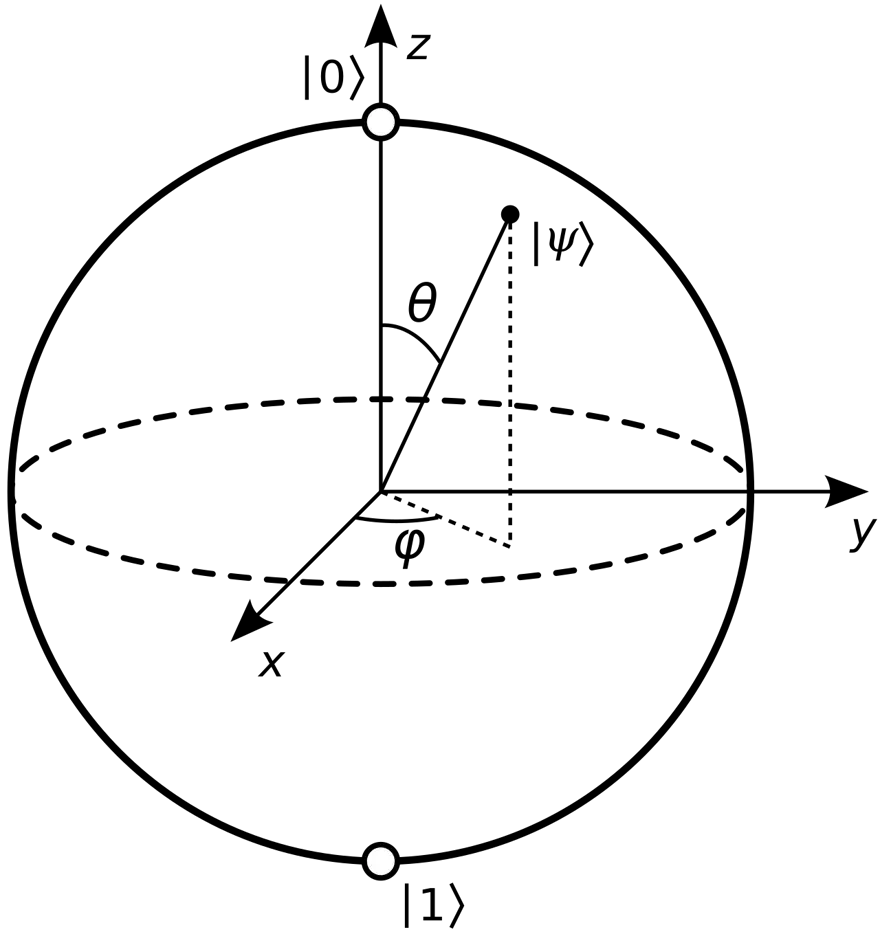
A qubit, drawn as a globe
Physicists picture a single two-state quantum system as a point on a sphere. The north and south poles are the two definite answers — call them 0 and 1. Every other point on the surface is a legitimate superposition, a specific blend of the two. A lone qubit always sits somewhere clean and well-defined on this globe.
Entangle two qubits, though, and neither one has a point on its own sphere any more. Ask where the first qubit "is" and the honest answer is: nowhere in particular — it has no state of its own until you consult its partner. The description has moved off the two globes and into the space between them.
It is worth saying plainly what entanglement is not, because the popular imagination has built some tall tales on top of it. It is not a force, a beam, or a substance passing between the particles. It is not a hotline that lets one particle telephone the other. And, as we will see in detail, it is not a way to send a signal, a message, or any usable information faster than light — a point on which the mathematics is utterly unambiguous, even though the correlations themselves seem to leap across any distance. Entanglement is a fact about how quantum descriptions are stitched together, and its strangeness is real, but it is a subtler and more disciplined strangeness than the myths suggest.
02 — Origins
Einstein's great objection
Entanglement did not arrive as a discovery to be celebrated. It arrived as a complaint. In 1935, Albert Einstein, together with his younger colleagues Boris Podolsky and Nathan Rosen, published a short paper with a pointed title: "Can Quantum-Mechanical Description of Physical Reality Be Considered Complete?" The three authors — remembered ever since by their initials, EPR — thought the answer was no, and they built an ingenious argument to prove it.
Their reasoning went like this. Prepare two particles that interact and then fly apart, in a state where measuring one immediately tells you the corresponding property of the other. Now, they argued, measure the first particle's position; you can predict the second particle's position with certainty, without touching it. Alternatively, you could have chosen to measure the first particle's momentum, and then you could predict the second's momentum with certainty. Since you can predict either property of the distant particle without disturbing it in the slightest, both must have been real, definite properties all along — what EPR called "elements of reality". Yet quantum mechanics forbids a particle from having a definite position and momentum at the same time. Therefore, EPR concluded, quantum mechanics must be leaving something out. It was, in their word, incomplete.
The alternative they refused to accept was that measuring the first particle could somehow reach across space and fix the state of the second on the spot. That would require an influence travelling instantaneously between distant places, in flat contradiction, it seemed, to the spirit of relativity. Einstein found the idea intolerable and gave it the nickname that has stuck to it ever since. In a letter to Max Born he dismissed it as "spukhafte Fernwirkung" — spooky action at a distance — and declared he could not bring himself to believe the universe worked that way.
"I cannot seriously believe in it because the theory cannot be reconciled with the idea that physics should represent a reality in time and space, free from spooky actions at a distance." — Albert Einstein to Max Born, 1947
Niels Bohr, quantum theory's foremost champion, replied at once, though his answer was so cryptic that physicists still argue about exactly what he meant. His thrust was that EPR had smuggled in a classical assumption — that a particle must possess definite properties independent of how it is observed — and that this assumption simply does not hold in the quantum world. There was no spooky signal, Bohr insisted, because there were no pre-existing properties for a signal to reveal. The two particles were one inseparable system, described by one wavefunction, no matter how far apart they drifted.
For nearly thirty years, this looked like a philosophical stalemate, a matter of taste rather than science. One camp preferred to think that quantum mechanics was incomplete, and that the apparent randomness masked a deeper layer of hidden variables — real but unrecorded properties, carried by each particle, that determined the outcomes in advance and restored a sensible, local picture of the world. The other camp was content with the theory as it stood. Both camps made exactly the same experimental predictions. There seemed to be no way to tell them apart in the laboratory. The debate was, everyone assumed, untestable — a question for the seminar room and the wine bar, not the workbench.
That assumption turned out to be wrong, and its overturning is one of the great intellectual turns of twentieth-century physics. It came from a quiet Northern Irish physicist named John Stewart Bell, who took the EPR argument seriously enough to ask a question nobody had thought to ask: what if the two rival pictures did not, in fact, always agree? What if there were some experiment, some clever choice of measurements, where a universe of local hidden variables and a universe of genuine entanglement would give measurably different answers?

03 — The decisive idea
Anatomy of a Bell test
In 1964, working on a leave of absence from his day job designing particle accelerators, Bell proved a theorem of astonishing reach. He showed that any theory built on two reasonable-sounding assumptions — that the world is local (nothing influences anything else faster than light) and realist (particles carry definite properties whether or not we look) — must obey a strict mathematical limit on how strongly the results of separated measurements can be correlated. This limit is called a Bell inequality. And here was the sting in the tail: quantum mechanics predicts that entangled particles can break that limit. The two pictures did not always agree after all. The difference between them was not philosophy; it was a number you could measure.
The genius of Bell's result is that it does not depend on the details of any particular hidden-variable theory. It rules out an entire class of them at a single stroke — every conceivable local realist account, no matter how clever, present or future. If experiments show the inequality being violated, then no local, realistic story can ever explain the world, full stop. To grasp how a real Bell test is built, it helps to walk through its four essential ingredients.
The recipe, in four parts
Every Bell test, from the tabletop experiments of the 1970s to the loophole-free triumphs of 2015, shares the same skeleton: a source of entangled pairs, two distant stations that each choose a measurement at random, a stream of definite outcomes, and a careful tally of how often the two sides agree. Expand each panel to see what it is for.
The number at the heart of a modern Bell test comes from a refinement of Bell's original inequality devised in 1969 by John Clauser, Michael Horne, Abner Shimony and Richard Holt — the CHSH inequality. It combines the results of four different pairings of measurement settings into a single score. If the world is local and realistic, that score can never exceed 2. Quantum mechanics, for suitably chosen angles on a maximally entangled pair, pushes it to 2√2, about 2.83. Every careful experiment ever performed has landed on the quantum side of that line, and none has found the value staying below 2 where local realism demands it must. The verdict of nature, repeated now in laboratory after laboratory, is that Einstein's comforting local picture simply cannot be right.
04 — Taxonomy
What entanglement is good for
For decades, entanglement was studied purely to settle a point of principle. Then, from the 1980s onward, physicists realised something remarkable: this delicate quantum link is not just a curiosity but a resource — something you can spend, share, and put to work. Four families of application dominate the field.
Unbreakable keys
The most mature application is secure communication. In an entanglement-based scheme such as the one proposed by Artur Ekert in 1991, two parties share a stream of entangled pairs and measure them to build a shared secret key. The security rests not on the difficulty of a mathematical puzzle, but on the laws of physics: any eavesdropper who intercepts the particles unavoidably disturbs the entanglement, and a quick Bell test reveals their presence. Because a genuine Bell violation cannot be faked, the honest parties can even distrust their own equipment — the approach known as device-independent cryptography. Keys distributed this way are, in a strong and provable sense, secure against any future computer.
The engine of quantum computers
A quantum computer's advantage over an ordinary one depends on entanglement running through its register of qubits. Without it, a quantum machine can be simulated efficiently by a classical one and offers no speed-up at all. It is the vast web of entanglement among many qubits — a state too complex to write down on any conceivable classical memory — that gives algorithms for factoring numbers or simulating molecules their potential power. Building and preserving that entanglement across dozens, then hundreds, then millions of qubits is essentially what the entire quantum-computing effort is trying to achieve.
Quantum teleportation
Despite the name, nothing physical is beamed anywhere and nobody is dematerialised. Quantum teleportation is a protocol for transferring the exact quantum state of one particle onto another, distant particle, using a shared entangled pair as a channel. The catch — and it is the whole point — is that it also requires two ordinary classical bits of information to be sent by conventional means. Those bits travel no faster than light, and without them the receiving end holds only meaningless noise. Teleportation moves the description, not the matter, and it does so strictly within the speed limit.
Sharper senses
Entangled particles can be marshalled to measure things more precisely than any collection of independent particles could. By correlating many probes, quantum metrology beats the usual statistical limits on precision, sharpening atomic clocks, gravitational-wave detectors and magnetic sensors. The gravitational-wave observatory LIGO already injects specially prepared "squeezed" quantum light to reduce its noise — a working, everyday use of quantum correlations to hear the universe more clearly.
Something you can run out of
Entanglement behaves like a fuel. Every teleportation, every shared key, every distributed computation consumes entangled pairs, and they must be replenished. This accountancy — how much entanglement a task needs and how to make more of it — has grown into an entire branch of physics called quantum information theory.
The reason it's hard
The same openness that lets entanglement span a laboratory makes it desperately easy to spoil. A single stray interaction with the surrounding world can sever the link. Taming that fragility — the problem of decoherence — is the central engineering challenge standing between today's prototypes and a useful quantum future.
05 — The evidence
Putting the ghost on trial
Bell had turned a philosophical dispute into an experimental one, but somebody still had to do the experiment — and in the early 1970s that was fearsomely hard. Entangled photons had to be made one pair at a time, detected with balky equipment, and counted by the thousand to beat down the statistical noise. The first person willing to try was a young American physicist named John Clauser, who was warned by senior colleagues that testing something as settled as quantum mechanics was a poor career move. He did it anyway.
In 1972, Clauser and his student Stuart Freedman, working at Berkeley, measured the polarisation correlations of photon pairs emitted by calcium atoms and found a clear violation of Bell's inequality. Quantum mechanics was right; local hidden variables were in trouble. But the early experiments had gaps — "loopholes", places where a sufficiently stubborn local realist could still wriggle free. The two big ones were the locality loophole (perhaps the two stations, or the source, were subtly communicating) and the detection loophole (perhaps the photons that happened to be detected were an unrepresentative sample).
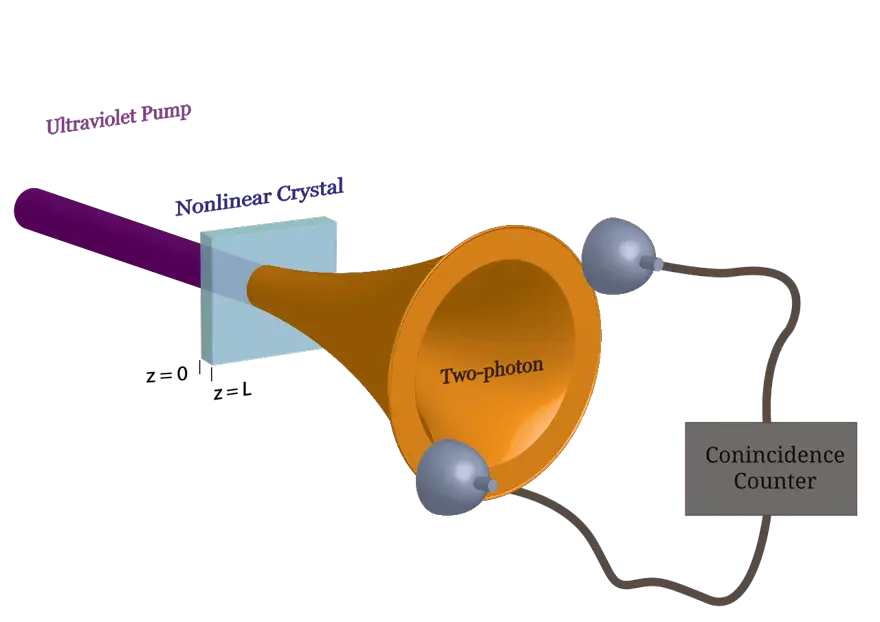
A better source of pairs
The experiments were transformed by a technique called spontaneous parametric down-conversion. Shine a laser into a specially cut crystal, and just occasionally a single high-energy photon splits into two lower-energy photons, born already entangled and flying out along paired paths.
This gave physicists a bright, reliable fountain of entangled photons, and it remains the workhorse of quantum-optics laboratories to this day — the source behind the crystal in countless Bell tests, teleportation demonstrations and cryptography experiments.
The next great advance came from France. In the early 1980s, Alain Aspect and his colleagues in Orsay closed the locality loophole with a beautiful stroke: they switched the orientation of their analysers so fast — while the photons were already in flight — that no signal travelling at light-speed could have carried news of one station's setting to the other in time to influence the result. The correlations survived. Whatever binds entangled particles, it was not a hidden message sneaking between the detectors.
Then came the Vienna school, led by Anton Zeilinger, which spent the 1990s and 2000s pushing entanglement to ever greater distances and complexity — entangling three and more photons at once, demonstrating quantum teleportation across a laboratory and later across the River Danube, and eventually beaming entangled photons between mountaintops and down from a satellite. But one prize remained: an experiment that closed every loophole at once, leaving the local realist no hiding place at all.
That prize was claimed in 2015. In a landmark experiment at Delft, Ronald Hanson's group entangled electrons held in diamonds more than a kilometre apart, closing the locality and detection loopholes simultaneously for the first time. Within months, two more groups — one in Vienna, one at the American standards laboratory NIST — achieved loophole-free violations with photons. After eighty years, the question EPR had raised was answered as decisively as experiment allows: the world is not locally real. Some cherished assumption — locality, or definite pre-existing properties, or both — has to go.
The scientific community's judgement arrived in the most public form possible. In 2022, the Nobel Prize in Physics was awarded jointly to John Clauser, Alain Aspect and Anton Zeilinger "for experiments with entangled photons, establishing the violation of Bell inequalities and pioneering quantum information science". A phenomenon Einstein had invoked to argue that quantum theory could not be the final word had become the foundation of a whole new technology — and its discoverers had been honoured for proving the spooky action real.
05½ — The myth, dismantled
Why you can't send a message with it
Here we must confront the single most common misunderstanding about entanglement, the one that launches a thousand breathless headlines about faster-than-light communication. If measuring my particle instantly determines the state of yours a galaxy away, surely I can wiggle mine to spell out a message and you can read it off yours, beating light itself? The answer is an emphatic and provable no, and understanding why reveals something profound about how nature protects its own consistency.
The reason is this: when you look at your particle alone, you see nothing but random noise. Whatever I do to my particle — whichever measurement I choose, whatever result I happen to get — the raw statistics you record on your side are exactly the same. Perfectly random, every time, regardless of my actions. You cannot tell from your results alone whether I have measured my particle, how I measured it, or even whether I exist. The correlation between our results is real and unmistakable, but it only becomes visible when we bring our two lists together and compare them line by line — and to do that, we have to communicate by some ordinary channel, which crawls along no faster than light.
The no-communication theorem
This is not a happy accident or an engineering limitation to be overcome with better kit. It is a theorem, proved rigorously from the structure of quantum mechanics itself. No operation you perform on your half of an entangled pair can change the measurable statistics on the other half. Entanglement can share correlation, but never causation. The door to faster-than-light signalling is not merely locked — it was never built.
Peace with relativity
This is exactly why entanglement, for all its spookiness, does not overthrow Einstein's relativity. Relativity forbids sending information faster than light, because that would let you send messages into your own past and unravel cause and effect. Entanglement never sends information faster than light. It threads the needle perfectly: the correlations are non-local, but the causation stays strictly obedient to the cosmic speed limit.
It is a delicate and, on reflection, rather elegant arrangement. Nature allows two distant events to be more tightly coordinated than any local story can explain, and yet arranges matters so that this coordination can never be exploited to carry a single usable bit across space instantaneously. You get the mystery without the paradox. Whenever you read that scientists have used entanglement to communicate faster than light, you can be confident that something has been lost in translation — because the theorem that forbids it is as solid as anything in physics.
06 — Where meaning breaks
What it all means
Bell tests tell us, beyond reasonable doubt, that the world is not locally real. What they do not tell us is which comfortable assumption to abandon, or what picture of reality to put in its place. This is where hard experiment hands off to genuine, unresolved interpretation — and where physicists who agree on every number can still disagree profoundly about what those numbers mean.
The quantum ceiling
The maximum CHSH value quantum mechanics allows — 2√2 — comfortably above the local realist limit of 2, and the value experiments keep finding. Curiously, nature does not push all the way to the logically possible maximum of 4, a restraint physicists are still trying to explain.
Entanglement from orbit
In 2017, China's Micius satellite distributed entangled photons to two ground stations more than a thousand kilometres apart, confirming that the correlations hold over distances that dwarf any laboratory — and pointing the way to a global quantum network.
The fragility clock
Left exposed to a warm, jostling environment, entanglement can survive for only microseconds or less before it leaks away. Protecting it long enough to be useful is the defining struggle of quantum engineering.
The leaking-away has a name — decoherence — and it is the quiet answer to a question that puzzles many newcomers: if everything is quantum, why don't we see superpositions and entanglement in everyday life? Why is a cricket ball never in two places at once? The answer is that large objects are relentlessly entangling with their surroundings. Every air molecule that bounces off, every photon that scatters, every stray vibration carries away a little of the object's quantum coherence into the wider environment, where it is hopelessly scrambled and lost. Entanglement is not destroyed so much as diluted — spread so thinly across countless particles that it can never be gathered back. Decoherence is why the quantum world looks classical at our scale, and it is the reason building a quantum computer means fighting, at every turn, to keep the fragile web of entanglement sealed off from the world.
As for the deeper question — what is really going on — physics offers not one answer but a family of competing interpretations, each fully consistent with every experiment and yet painting a wholly different portrait of reality. The oldest, loosely called the Copenhagen interpretation, holds that the wavefunction is not a physical thing but a summary of our knowledge, and that measurement simply updates it; ask what the particle "was" beforehand and the question is dismissed as meaningless. The many-worlds interpretation takes the opposite view: the wavefunction is real and never collapses at all, and every possible outcome genuinely happens, each in its own branch of a constantly splitting universe, so that entanglement is simply the branches of two systems becoming correlated. The pilot-wave picture of de Broglie and Bohm keeps definite particles with definite positions but pays for it with an openly non-local guiding field — accepting the spooky action Einstein hated in exchange for a return to determinism.
Each of these interpretations reproduces the Bell violations exactly. None can currently be tested against the others, and reasonable physicists line up behind all of them. What Bell's theorem accomplished was not to settle the interpretation but to sharpen the stakes: it proved that whatever story we tell, it cannot be both local and realistic in the old-fashioned sense. That is a hard, permanent constraint on any acceptable picture of the world — and, three human generations after EPR, deciding which of the surviving pictures is right remains one of the most genuinely open questions in all of science.
06½ — The next network
The quantum internet
If entanglement is a resource, then the natural next step is to build the infrastructure to distribute it — a network whose links are not carrying data in the ordinary sense, but sharing entangled pairs between distant nodes. Researchers call this ambition the quantum internet, and while it is still in its infancy, its outlines are already taking shape in laboratories on several continents.
The central difficulty is distance. Photons sent down an optical fibre are absorbed as they travel, and unlike an ordinary signal, an unknown quantum state cannot simply be copied and amplified along the way — a deep result called the no-cloning theorem forbids it. So the naïve approach fails after a few hundred kilometres. The solution is one of the most beautiful tricks in the field: entanglement swapping.
Swapping, in brief
Take two separate entangled pairs — A–B and C–D. Bring B and C together and perform a joint measurement on them. Astonishingly, this leaves A and D entangled, even though they were created independently and have never met. Chain many such swaps together, and entanglement can be extended, link by link, across a whole continent.
The devices that perform these swaps at intervals along a network are called quantum repeaters, and they are the key enabling technology the field is racing to perfect. Combined with satellites like Micius, which can leapfrog the atmosphere to link ground stations thousands of kilometres apart, they sketch a plausible route to a genuinely global web of shared entanglement. Such a network would not replace the ordinary internet — it would sit alongside it, offering things the classical internet fundamentally cannot: cryptographic keys secured by physics rather than mathematics, clusters of quantum computers pooled into one larger machine, and telescopes and clocks linked so tightly that they act as a single planet-sized instrument. It is early days, and formidable obstacles remain. But the principle has been demonstrated, pair by painstaking pair, and the spooky action Einstein could not abide is quietly becoming the backbone of a new kind of communications technology.
07 — History
A short history of a long argument
- 1935
The EPR paper
Einstein, Podolsky and Rosen argue that quantum mechanics must be incomplete, and Schrödinger, replying the same year, coins the term "entanglement" for the strange link at the heart of their thought experiment.
- 1964
Bell's theorem
John Stewart Bell proves that no local hidden-variable theory can reproduce all the predictions of quantum mechanics, turning a philosophical debate into a question experiments can settle.
- 1972
The first test
Stuart Freedman and John Clauser measure photon pairs from calcium atoms at Berkeley and find the first experimental violation of a Bell inequality.
- 1982
Closing the locality loophole
Alain Aspect's team in Orsay switches its analysers while the photons are in flight, ruling out any hidden signal passing between the two stations.
- 1997
Teleportation demonstrated
A group in Innsbruck led by Anton Zeilinger performs the first experimental quantum teleportation, transferring a photon's state onto a distant photon using a shared entangled pair.
- 2015
Loophole-free at last
Groups in Delft, Vienna and Boulder independently close every major loophole at once, leaving local realism with no place left to hide.
- 2022
The Nobel Prize
Clauser, Aspect and Zeilinger share the Nobel Prize in Physics for their pioneering experiments with entangled photons and the founding of quantum information science.
08 — Common questions
Questions people actually ask
09 — A closing thought
Why the spookiness is worth it
There is a lovely irony at the centre of this story. Entanglement entered physics as an embarrassment — a feature Einstein pointed to in order to argue that quantum mechanics could not possibly be the whole truth. He was one of the deepest thinkers who ever lived, and on this he backed the losing side. But he was wrong in a way that only a great physicist can be: his objection was so sharp, so precisely aimed, that it eventually became a tool for measuring reality. The very thing he offered as evidence against the theory turned out to be one of its most profound and useful truths.
What makes entanglement matter, in the end, is not that it is weird — plenty of things are weird — but that it is weird in a disciplined, quantifiable, testable way. It gave us a number, the Bell inequality, that draws a line between the universe we naïvely expected and the universe we actually inhabit. On our side of that line, particles do not carry all their properties around with them like luggage, and distant events can be woven together more tightly than any local account permits. That is not a failure of our instruments or a gap in our knowledge. As far as every experiment can tell, it is simply how the world is built.
And so we keep pushing — entangling more particles, over greater distances, for longer times, closing the last loopholes and building the first fragile quantum networks. We do it partly for the technologies it promises: uncrackable codes, powerful computers, exquisitely sensitive instruments. But we also do it for the older reason, the one that drove Einstein and Bohr and Bell to argue for decades over a thought experiment. Entanglement is nature being honest with us about how strange it really is beneath the familiar surface — and once you have seen the ghost caught in the laboratory, measured and counted and put to work, it is very hard to look away.
The link is real. The magic is not.
Entanglement began as Einstein's objection and became quantum theory's crown jewel. It binds distant particles more tightly than any classical story allows — and yet it cannot carry a single message across the void. The spooky action is real, disciplined, and, at last, ours to use.