01 — Definition
What, exactly, is dark matter?
Imagine standing in a pitch-black room and feeling a wind you cannot see, a current strong enough to lean against. You cannot touch its source or shine a light on it, yet its effects are everywhere and unmistakable. Dark matter is something like that wind, written across the entire sky. It is a form of matter that neither gives off nor absorbs light of any kind — not visible, not radio, not X-ray — and so remains completely invisible to every telescope ever built. We know it is there only because we can feel its gravity, tugging on the stars, the galaxies and the light that streams past it. And by that tug we can weigh it: there is roughly five times more of this unseen stuff than there is of all the ordinary matter that makes up planets, stars, gas and people combined.
The word "dark" is doing careful work here. It does not mean black, or shadowed, or hidden behind something. A cloud of cold gas is dark in the everyday sense — you cannot see it directly — but it still interacts with light, blocking or dimming what lies behind it, and it will glow if you heat it. Dark matter does none of this. As far as we can tell it is entirely transparent, sliding through ordinary matter and through itself as though nothing were there. Light passes clean through it. It is not that we have failed to point our instruments in the right direction; it is that this substance simply does not engage with the electromagnetic force, the force responsible for all light and for the solidity of everything we touch.
So what does it do? It has mass, and mass gravitates. That single property is enough to make dark matter one of the most important ingredients in the universe. Its gravity is the invisible scaffolding on which the visible cosmos is hung. Galaxies spin faster than their stars alone could explain; clusters of galaxies are bound together far more tightly than their glowing contents should allow; the light from distant galaxies is bent and magnified by masses we cannot see. In every case the sums only balance if there is a great deal of extra matter present — matter that shines with no light at all.
"We are not the main event. The luminous universe — every star and galaxy you have ever seen — is a thin bright froth on a deep, dark ocean we are only beginning to chart."
It is worth being honest about the size of the confession buried in the name. To call something "dark matter" is really to admit ignorance dressed as a label: it is our placeholder for whatever supplies the missing gravity. The evidence that something is there is overwhelming and comes from half a dozen independent directions that all agree. But the question of what that something actually is — whether it is a new kind of fundamental particle, a swarm of unseen objects, or a sign that our theory of gravity itself is incomplete — remains genuinely open. Dark matter is, in that sense, the largest known unknown in physics: a fact we are certain of, wrapped around a mystery we have not solved.
One more misconception is worth clearing away at the outset. Dark matter is not the same thing as dark energy, despite the unfortunate similarity of the names. Dark matter is a form of matter; it clumps under gravity and pulls things together, and it is the subject of this guide. Dark energy is something else entirely — a mysterious property of empty space that pushes the universe apart, accelerating its expansion. The two are cosmic strangers who happen to share an adjective. Together with the small sliver of ordinary matter, they make up the strange inventory of the universe, and dark matter is the part we can at least locate, map, and hope one day to catch.
02 — Origins of the idea
A century of accumulating clues
The story of dark matter is not the story of a discovery so much as a slow, reluctant realisation, forced on astronomers again and again by numbers that would not add up. It begins in earnest in 1933, with a brilliant, prickly Swiss-American astronomer named Fritz Zwicky. Studying the Coma cluster — a great swarm of over a thousand galaxies — Zwicky measured how fast its member galaxies were moving relative to one another. They were racing about far too quickly. The combined gravity of all the visible galaxies, he calculated, was nowhere near strong enough to hold the swarm together; at those speeds the cluster should long ago have flung itself apart, like a merry-go-round spinning so fast that the riders fly off.
Yet the cluster was manifestly still there. Zwicky concluded that it must contain a vast amount of unseen mass supplying the missing gravitational glue — perhaps a hundred times more than the luminous matter he could count. He gave it a name: dunkle Materie, dark matter. It was a startling claim, and for decades it was largely set aside. Zwicky was abrasive and made enemies easily, his estimates were rough, and the idea of a universe dominated by invisible stuff was simply too radical to embrace on the strength of one measurement. The clue was filed away and half-forgotten.
The curve that would not fall
In a galaxy, as in the solar system, gravity should make the outermost objects orbit slowest. Pluto crawls; Mercury sprints. Astronomers expected the outer stars of a galaxy to lag behind in just the same way. Instead they found the speeds staying stubbornly high, all the way out — a flat line where physics demanded a downward slope.
The clue that finally made the case impossible to ignore came in the 1970s, from the American astronomer Vera Rubin and her collaborator Kent Ford. They set out to measure something apparently mundane: how fast stars orbit within spiral galaxies, as a function of their distance from the centre. The expectation, drawn straight from Newton and confirmed in our own solar system, was clear. Most of a galaxy's visible mass is concentrated in its bright central bulge, so stars far out in the sparse outskirts should feel weaker gravity and orbit more slowly, just as the outer planets do around the Sun.
That is emphatically not what Rubin found. Galaxy after galaxy, the stars in the outer reaches were orbiting just as fast as those nearer the centre. The "rotation curves" she measured did not fall away with distance; they flattened out and stayed high, far beyond the edge of the visible disc. There was only one straightforward way to make sense of it: each galaxy must be embedded in a vast, roughly spherical halo of unseen matter, extending well past its luminous edge and containing several times more mass than all its stars. The stars in the outskirts orbited quickly because they were feeling the gravity of this enormous invisible cocoon.
Rubin's rotation curves were decisive in a way Zwicky's cluster had not been. They were clean, repeatable, and found in essentially every spiral galaxy examined. What had been a curious anomaly in one cluster became a universal feature of galaxies everywhere. By the early 1980s the weight of evidence had tipped, and dark matter moved from the fringe to the mainstream — not because anyone had seen it, but because its gravitational fingerprints were suddenly turning up on everything. Rubin herself was characteristically modest about it, noting that nature had simply handed her a result she could not explain away, and that the honest thing to do was report it.
03 — The case, examined
The anatomy of the evidence
What makes dark matter so hard to dismiss is not any single observation but the way several completely independent lines of evidence — drawn from different objects, different distances and different physics — all point to the same conclusion and even agree on the same amount. If dark matter were a mistake, it would have to be a mistake that conspires across the whole of astronomy. Working through the strongest pillars of the case:
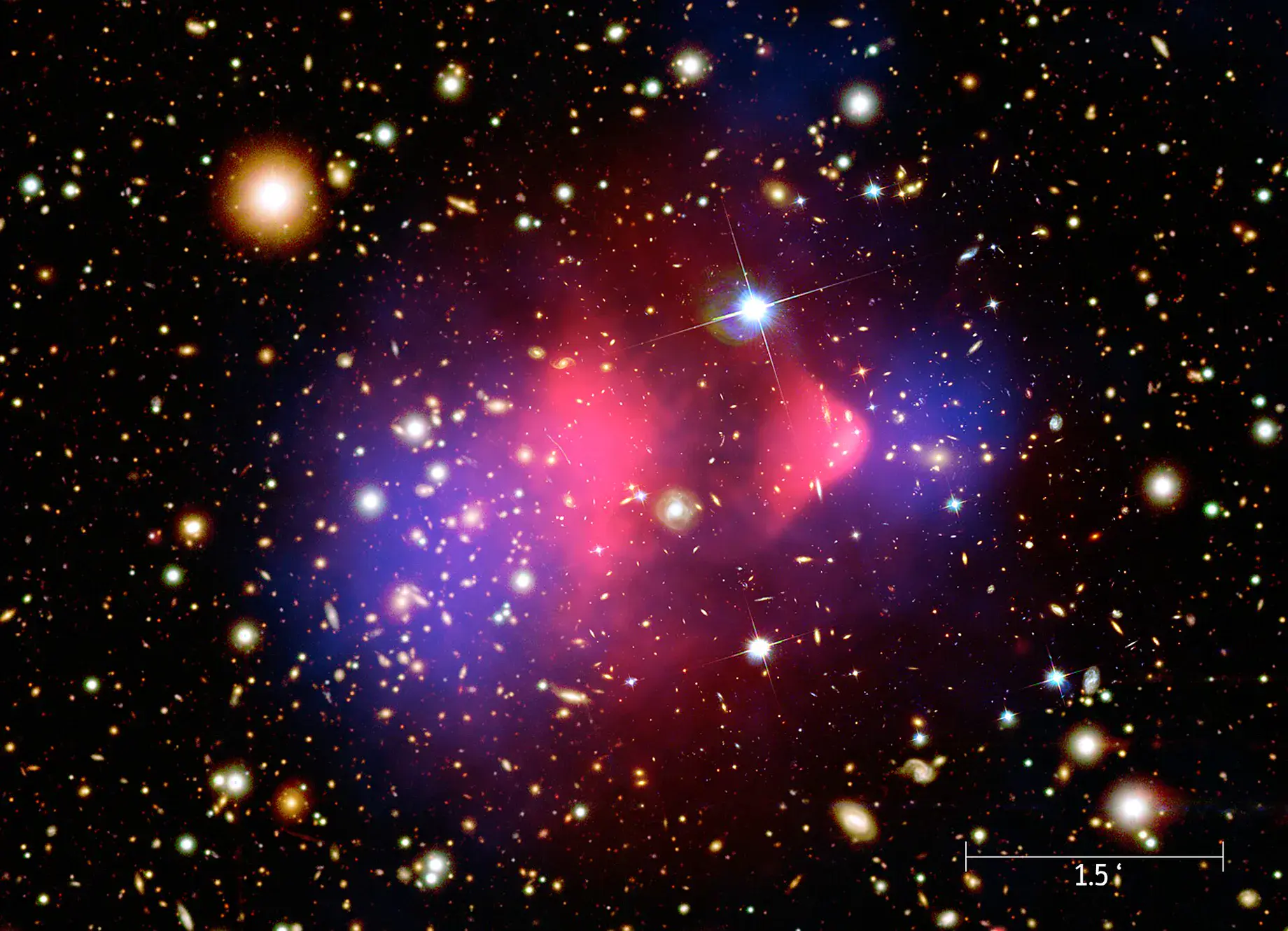
The single most vivid piece of evidence, though, deserves to be singled out — the one many physicists point to as the "smoking gun." It is the Bullet Cluster, pictured at the top of this guide: two galaxy clusters caught in the aftermath of a colossal collision. When they passed through one another, their stars and galaxies — being mostly empty space — sailed on almost untouched, but their vast clouds of hot gas, which make up most of the ordinary matter, crashed together and were left dragging behind in the middle, glowing in X-rays. If ordinary matter were all there is, the cluster's mass should sit where that gas is.
But it does not. Gravitational lensing lets astronomers map where the mass actually lies, and the mass has sailed on ahead with the galaxies, cleanly separated from the gas that holds most of the visible material. The bulk of each cluster's weight is somewhere the light is not. That separation is exactly what dark matter predicts and exceedingly hard to explain otherwise: an unseen, non-interacting mass that swept straight through the collision while the ordinary gas piled up. The Bullet Cluster turned an inference into something close to a direct sighting of dark matter's shadow.
03½ — Weighing with light
How to weigh the invisible
One of the most elegant tools in the whole investigation flows straight from Einstein's general relativity: the idea that mass bends space, and that light travelling through bent space follows a curved path. A sufficiently massive object acts as a lens, deflecting and focusing the light of whatever lies behind it. Because the amount of bending depends only on how much mass is present — not on whether that mass shines — gravitational lensing lets astronomers weigh things they cannot see at all. It is, quite literally, a way of reading mass by watching light take a detour around it.
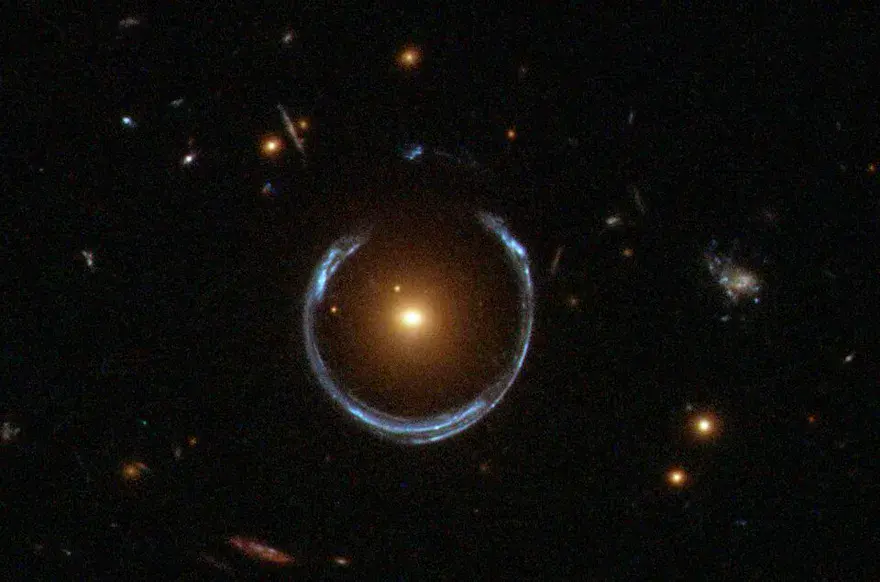
Lensing comes in two flavours. In strong lensing, a massive foreground galaxy or cluster sits almost perfectly in front of a distant source, smearing its light into dramatic arcs or, when the alignment is near-perfect, a complete circle called an Einstein ring — like the "Cosmic Horseshoe" pictured above, where a whole background galaxy has been wrapped into a luminous loop. From the size of that ring, the mass of the lens can be calculated with real precision. Time and again the answer comes back the same: the lens is far heavier than its visible stars and gas, weighed down by an unseen majority.
Far more common, and in some ways more powerful, is weak lensing. Here the alignment is imperfect and the effect is subtle: the images of millions of faint background galaxies are each stretched by a fraction of a percent, tugged into slight alignment by the mass they pass. No single galaxy reveals much, but by statistically averaging the tiny distortions across enormous swathes of sky, astronomers can reconstruct a map of where the mass actually lies — a map of dark matter itself, drawn from the gentle shearing of distant light. These "mass maps" reveal the invisible cosmos laid bare: a lumpy, filamentary landscape of dark matter, with the glowing galaxies clustered obediently in its densest knots.
04 — The line-up
The prime suspects
If dark matter is a substance, what is it made of? Whatever it is must have mass, must be effectively invisible, must be stable enough to have survived since the early universe, and must be "cold" — moving slowly enough to clump into the halos we observe. Several candidates fit that profile, each with passionate advocates. Here are the leading suspects.
WIMPs
For decades the front-runner. A WIMP would be a heavy particle — perhaps tens to hundreds of times the mass of a proton — that feels gravity and the weak nuclear force but not electromagnetism, so it neither shines nor blocks light. Their appeal lies in a striking coincidence: a particle with roughly the mass and interaction strength predicted by theories such as supersymmetry would naturally have been produced in the early universe in just the right abundance to be today's dark matter. This tidy fit, dubbed the "WIMP miracle," inspired a generation of experiments — though the failure so far to detect one has begun to dim the enthusiasm.
Axions
A radically different bet: instead of one heavy particle, an immense sea of extraordinarily light ones. The axion was first dreamed up not to explain dark matter at all, but to fix an unrelated puzzle in the theory of the strong nuclear force — and it turned out, almost as a bonus, to be an excellent dark-matter candidate. An axion might weigh less than a trillionth of an electron, so ghostly that trillions could pass through a fingernail unnoticed, yet in vast enough numbers they could supply all the missing mass. Ingenious experiments now try to coax axions into converting into faint microwave photons inside powerful magnetic fields.
Sterile neutrinos
Ordinary neutrinos are already nearly invisible ghosts, streaming through the Earth by the trillion. A sterile neutrino would be even more aloof — a hypothetical heavier relative that ignores every force except gravity, refusing even the feeble weak interactions its ordinary cousins feel. That extreme shyness makes it a natural dark-matter candidate. Some versions might very slowly decay, producing a faint, tell-tale X-ray glow, and astronomers have searched the sky for exactly such a signal, so far without a confirmed detection.
MACHOs
A conservative alternative to exotic particles: what if the dark matter were simply ordinary stuff that happens not to shine — burnt-out stars, stray planets, or black holes drifting unseen through the galactic halo? Astronomers hunted for these "massive compact halo objects" by watching for the momentary brightening they would cause when passing in front of a background star, a lensing flicker called microlensing. The searches found some objects, but nowhere near enough to account for the dark matter — and other evidence rules out ordinary matter as the bulk of it. MACHOs are now largely out of the running, though primordial black holes keep a slim version of the idea alive.
Cold, warm, or hot?
Beyond the specific particle, one property matters enormously: how fast the dark matter was moving in the early universe. "Hot" dark matter, zipping near light-speed, would have smoothed out the small lumps and built the largest structures first. "Cold" dark matter, moving sluggishly, lets small clumps form early and merge into bigger ones — the pattern we actually see.
The evidence overwhelmingly favours cold dark matter, which is why the leading model of cosmology is called Lambda-CDM: a universe of cold dark matter (CDM) plus dark energy (Lambda). Axions and WIMPs both qualify as cold; ordinary neutrinos, too light and too fast, are ruled out as the main component.
Why not just ordinary gas?
It is a natural first thought: perhaps the missing mass is simply cold gas, faint dust, or dim failed stars we have overlooked. But this idea runs into a hard wall. The abundances of the light elements forged in the Big Bang, and the detailed pattern of the cosmic microwave background, both independently fix how much ordinary matter the universe contains — and it is far too little. The dark matter must be something genuinely different in kind, not merely ordinary matter with the lights off.
05 — The search
Three ways to catch a ghost
Knowing dark matter exists is one thing; catching a piece of it is quite another. If it really is a new particle, then untold numbers of them are streaming through your body every second, and the whole planet is ploughing through a wind of the stuff as the Sun orbits the galaxy. The trouble is that such particles almost never interact with anything, so a "collision" with ordinary matter is fantastically rare. To catch even a handful, physicists have devised three complementary strategies, each attacking the problem from a different angle.
The first and most direct is to build an exquisitely sensitive detector and simply wait for a passing dark-matter particle to bump into an atomic nucleus inside it. Because such a bump would be almost unimaginably faint and rare, these direct-detection experiments are buried deep underground — in old mines and under mountains — where a kilometre or more of rock screens out the constant rain of cosmic rays that would otherwise drown the signal. Inside, tanks of ultra-pure liquid xenon or crystals chilled to a whisper above absolute zero sit in near-perfect stillness, watching for the tiny flash or recoil that a single struck nucleus would produce. It is a bit like listening for one particular raindrop landing on a drum, in a thunderstorm, from inside a vault.
Direct detection
Deep-underground tanks of liquid xenon or cryogenic crystals wait for a dark-matter particle to nudge a nucleus. Ever-larger, ever-quieter detectors have pushed the sensitivity down for decades — so far recording silence, which itself narrows the possibilities.
Indirect detection
Where dark matter is densest, particles may occasionally annihilate or decay, producing gamma rays, antimatter or neutrinos. Space telescopes and observatories scan the galactic centre and dwarf galaxies for these tell-tale by-products of dark matter destroying itself.
Collider searches
At the Large Hadron Collider, physicists smash protons together hoping to create dark-matter particles. Being invisible, any that formed would escape unseen — betrayed only by a tell-tale imbalance, a chunk of missing momentum in the debris.
The second strategy turns the problem inside out: instead of waiting for dark matter to hit us, look for places in the sky where it might be destroying itself. In regions where dark matter is packed densely — the crowded centre of our galaxy, or the small, dark-matter-dominated dwarf galaxies orbiting the Milky Way — particles may occasionally collide and annihilate, or slowly decay, converting their mass into a spray of ordinary particles: gamma rays, antimatter, or neutrinos. Indirect detection means hunting for these by-products with space telescopes and ground observatories, watching for an excess of high-energy light or antimatter that ordinary astrophysics cannot explain. Tantalising hints have appeared over the years, but none has yet held up as an unambiguous signal.
The third strategy is the boldest: rather than find dark matter in the wild, make some. At the Large Hadron Collider near Geneva, protons are hurled together at nearly the speed of light, and if dark-matter particles are light enough to be produced in the wreckage, some should appear. The catch is that they would fly out of the detector invisibly, leaving no track. Physicists catch them by accounting: they add up the momentum of everything they can see, and if the books do not balance — if a chunk of momentum has vanished, carried off by something unseen — that missing energy could be the signature of dark matter escaping. So far the ledgers have balanced, tightening the limits without yet revealing the culprit.
It is worth dwelling on what decades of patient searching have and have not achieved. No experiment has yet made a confirmed, reproducible detection of a dark-matter particle. That might sound like failure, but it is really the ordinary grind of physics: each null result carves away another slice of the possibilities, ruling out whole ranges of masses and interaction strengths and forcing theorists to sharpen or abandon their ideas. The most popular WIMP candidates, in particular, have been squeezed hard by the silence of the underground detectors, pushing many researchers to look more seriously at axions and other alternatives. The ghost has not been caught — but the net is being drawn ever tighter.
06 — The bigger picture
Why a quarter of everything matters
Step back far enough and dark matter stops being a curiosity about galaxies and becomes a statement about the entire contents of the universe. When cosmologists take their best measurements — from the cosmic microwave background, from the large-scale distribution of galaxies, from the expansion history of the cosmos — and ask what the universe is actually made of, they arrive at a famously strange inventory. Everything we have ever seen, every atom in every star and planet and living thing, is a small minority of the whole.
Ordinary matter
Everything made of atoms — stars, planets, gas, dust, and us. The entire visible universe is a rounding error on the cosmic balance sheet.
Dark matter
Roughly five times more than ordinary matter, and the gravitational architect of every galaxy and cluster in the sky.
Dark energy
The dominant and most mysterious slice of all — the energy of empty space, driving the accelerating expansion of the universe.
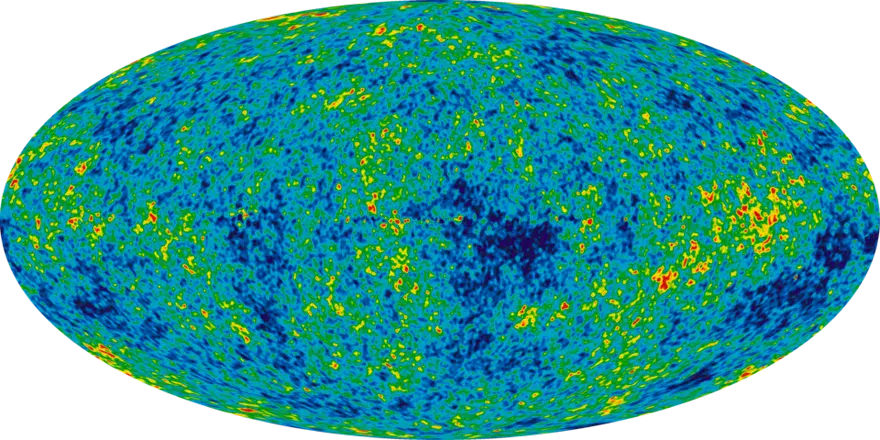
These proportions are not loose guesses. They come most precisely from the cosmic microwave background — the faint, uniform afterglow of the Big Bang, released when the infant universe first cooled enough to become transparent, some 380,000 years after it began. That ancient light, now stretched to microwaves, bathes the whole sky, and it is not perfectly smooth: it carries a delicate pattern of hot and cold spots, ripples imprinted by sound waves sloshing through the primordial plasma. Crucially, the exact sizes and spacing of those ripples depend on how much matter of each kind was present. Ordinary matter, which interacts with light, and dark matter, which does not, leave subtly different marks — and fitting the observed pattern pins down both amounts with remarkable precision.
The story the ripples tell is one of dark matter's finest hours. Because dark matter feels no pressure from light, it could begin clumping under gravity before ordinary matter was able to, sketching out the gravitational wells into which normal matter later fell to form galaxies. Run the cosmic clock forward in a computer with only ordinary matter, and you cannot build the structures we see in the time available — there simply is not enough gravity, soon enough, to gather them. Add cold dark matter and the simulated universe blossoms into a web of filaments, sheets and clusters that matches the real sky in astonishing detail. Dark matter is not just an accounting entry; it is the reason the universe has structure at all.
A snapshot of the newborn cosmos
Each speck of colour in this map is a tiny variation in temperature — no more than a few parts in a hundred thousand — in the light left over from the Big Bang. Hidden in the statistics of those specks is a full census of the universe: how fast it is expanding, how much ordinary matter it holds, and how much dark matter.
That a pattern in 13.8-billion-year-old light should agree so exactly with the way galaxies spin nearby is one of the quiet triumphs of modern science — two utterly different measurements converging on the same invisible substance.
06½ — The grand structure
The cosmic web
Zoom out beyond individual galaxies, beyond even clusters, to the largest scales we can survey, and the universe reveals a breathtaking architecture. Galaxies are not scattered at random through space; they are strung along vast filaments that stretch for hundreds of millions of light-years, meeting at dense knots and framing enormous, nearly empty voids. Astronomers call this the cosmic web, and it looks uncannily like a three-dimensional network of threads and hollows — the largest pattern in nature.
Dark matter is the loom on which this web was woven. In the early universe, its faint initial lumps grew under gravity into a scaffolding of dense ridges and sparse valleys. Ordinary gas, drawn along by that unseen gravity, drained down onto the ridges and pooled at the knots, where it condensed into galaxies. The luminous cosmic web we map with our telescopes is really the visible tracery picking out a far more massive, invisible web of dark matter beneath it — bright galaxies lighting up the dark scaffolding like dew revealing a spider's silk at dawn.
SCALES OF STRUCTURE
The remarkable thing is how well this all hangs together. Feed a supercomputer nothing but the measured amount of cold dark matter, the known laws of gravity, and the tiny ripples seen in the cosmic microwave background, and let it run for the equivalent of 13.8 billion years. What emerges is a simulated cosmic web whose statistics — the sizes of the voids, the lengths of the filaments, the clustering of the knots — match the real galaxy surveys with uncanny fidelity. It is hard to overstate how demanding that agreement is, and how completely it fails without dark matter in the recipe.
06¾ — The rival idea
MOND: what if there is no dark matter?
Not everyone is convinced the missing mass is real. There is a bold alternative that takes the anomalies entirely seriously but draws the opposite conclusion: perhaps there is no unseen matter, and instead our law of gravity is subtly wrong on galactic scales. This is the idea behind Modified Newtonian Dynamics, or MOND, proposed by the physicist Mordehai Milgrom in 1983.
Milgrom noticed that galaxies stop behaving as expected precisely where gravitational accelerations become extremely small. So he suggested a tweak: below a certain tiny threshold of acceleration, gravity falls off more gently than Newton's law predicts, growing stronger than expected. With this single modification and no dark matter at all, MOND reproduces the flat rotation curves of spiral galaxies with startling economy — often more neatly, and with fewer adjustable knobs, than dark-matter models manage.
The scorecard
Predicts individual galaxy rotation curves with remarkable accuracy and simplicity.
Uses no unseen substance — a genuine economy of ingredients.
Struggles badly with galaxy clusters, which still need extra unseen mass.
Cannot easily explain the Bullet Cluster or the cosmic microwave background.
MOND is a serious idea, and its successes on the scale of single galaxies are real and deserve respect — a good theory should account for them, and dark-matter models have had to work to match MOND's tidy galactic predictions. But the modification runs into deep trouble on larger scales. It cannot fully explain the motions within galaxy clusters without invoking some unseen mass anyway, and it struggles enormously with two of dark matter's strongest pieces of evidence: the Bullet Cluster, where the mass is plainly separated from the visible matter, and the exquisite pattern of the cosmic microwave background, which a simple change to gravity has great difficulty reproducing. Extending MOND into a full, relativistic theory that can handle the whole universe has proved forbiddingly hard. For now the majority view is that dark matter, for all its own mysteries, explains a far wider range of observations — but MOND remains a valuable, honest challenge, a reminder that the missing-mass problem could yet have a surprising resolution.
07 — History
A short history of the unseen
- 1933
Zwicky's missing mass
Studying the Coma cluster, Fritz Zwicky finds its galaxies moving far too fast to be held together by their visible mass, and coins the term dunkle Materie — dark matter.
- 1970s
Rubin's rotation curves
Vera Rubin and Kent Ford measure spiral galaxies spinning with flat rotation curves, revealing that each is wrapped in a massive halo of unseen matter. The evidence becomes impossible to ignore.
- 1983
A rival appears
Mordehai Milgrom proposes MOND, arguing that modifying gravity — rather than adding invisible matter — could explain the galactic anomalies.
- 1998
Enter dark energy
Two teams find the expansion of the universe is accelerating, revealing dark energy and completing the strange cosmic inventory in which dark matter is the middle slice.
- 2006
The Bullet Cluster
Lensing maps of a cluster collision show the mass cleanly separated from the visible gas — widely hailed as a "smoking gun" for dark matter as a substance.
- 2013
Planck takes the census
The Planck satellite's precise map of the cosmic microwave background fixes the recipe of the universe: about 5% ordinary matter, 27% dark matter, 68% dark energy.
- 2020s
The net tightens
Ever-larger underground detectors and vast sky surveys push the search onward — ruling out candidates, mapping dark matter across the sky, and keeping the central mystery gloriously open.
08 — Common questions
Questions people actually ask
09 — A closing thought
On being outnumbered in our own universe
There is a particular kind of humility in the study of dark matter. For most of history we assumed, quite naturally, that the universe was made of the same sort of stuff we are — atoms, arranged into stars and worlds and living things. The great lesson of the last century is that this assumption was almost exactly backwards. The luminous matter we can see, the entire glittering inventory of astronomy, turns out to be a faint minority ingredient, perhaps a twentieth of the whole. We are the exception, not the rule; the bright exception clinging to a dark and overwhelming majority.
And yet the case for that majority was not built on speculation but on relentless, careful measurement. Zwicky counted galaxies and found the sums did not balance. Rubin tracked stars and found them moving too fast. Others weighed clusters with bent light, read the recipe of the cosmos in the afterglow of the Big Bang, and watched the invisible scaffolding assemble itself in simulations that match the real sky. No single result would compel belief; together, converging from every direction, they leave little room for doubt that the universe is dominated by something we cannot see. That is not a failure of observation. It is one of its greatest achievements — to have mapped, weighed and charted a substance that gives off no light at all.
What remains is the deepest question of all: what is it? For that we are still waiting — for a flash in a detector a kilometre underground, for a whisper of gamma rays from the galactic centre, for a particle conjured from a collision, or perhaps for a revolution in our understanding of gravity itself. Any of these would rank among the greatest discoveries in the history of science, and any of them could arrive next year or not for a generation. Until then, dark matter stands as a standing invitation: proof, written across the whole sky, that the universe is stranger and larger than it looks, and that most of it is still waiting to be understood.
Most of the universe is still in the dark.
A century ago dark matter was one astronomer's inconvenient arithmetic. Today it is woven through every map of the cosmos — the invisible scaffolding of galaxies, clusters and the great cosmic web. We have weighed it, mapped it, and traced its work across 13.8 billion years. We have simply never seen it. Not yet.