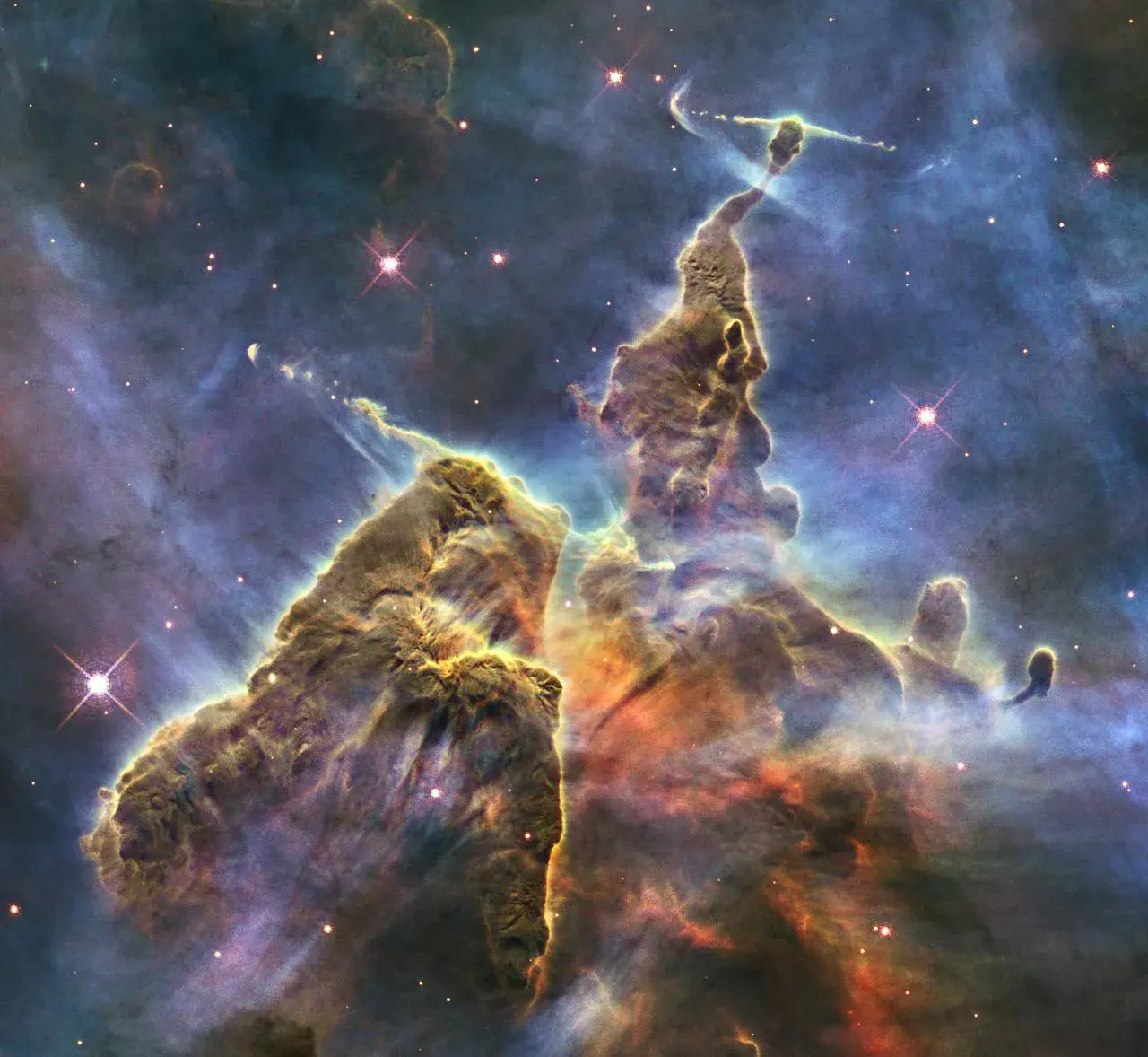
01 — Definition
What, exactly, is a nebula?
Space between the stars is not empty. It only looks that way to the naked eye. Spread through the dark gaps of every galaxy is a thin haze of gas and microscopic dust — hydrogen mostly, with a pinch of helium and a trace of heavier atoms — and where that haze gathers into a recognisable cloud, we call it a nebula. The word is simply Latin for "cloud" or "mist," and it is a fair description: a nebula is a cloud in space, sometimes light-years across, sometimes glowing like a paper lantern, sometimes lurking as a silhouette blacker than the sky behind it.
What makes nebulae worth a field guide of their own is that they are not merely scenery. They are the stage on which the entire life story of stars plays out. A star does not appear from nowhere; it condenses out of a nebula. When it dies, whether gently or in a titanic explosion, it hands much of its substance back to the surrounding gas, enriching it with the elements cooked in its core. That enriched cloud can then collapse again into a new generation of stars. A nebula is both a nursery and a graveyard, and often the two roles are inseparable — the ashes of one star become the raw material of the next.
It helps to hold two very different mental images at once. On the one hand, a nebula can be genuinely enormous, dwarfing entire solar systems and taking light years to cross. On the other hand, it is almost unimaginably tenuous. The gas in a typical glowing nebula is thinner than the best vacuum we can create in a laboratory on Earth — a few hundred to a few thousand atoms per cubic centimetre, against the roughly thirty billion billion in the air you are breathing. If you could scoop up a chunk of the Orion Nebula the size of the Earth, you would gather barely enough matter to be worth mentioning. Nebulae are, in a sense, mostly nothing at all. They only appear substantial because there is so very much of that nothing, stacked light-year upon light-year along our line of sight.
"We are made of star-stuff." — Carl Sagan, capturing in four words the fact that the calcium in your bones and the iron in your blood were first assembled inside stars and scattered by them into clouds like these.
There is one more distinction worth settling straight away, because it caused a century of confusion. For a long time astronomers used the word "nebula" for anything in the sky that looked like a fuzzy patch rather than a crisp point of light. That net caught two utterly different kinds of fish. Some of those fuzzy patches really were clouds of gas within our own Milky Way. But others turned out to be entire separate galaxies — the "spiral nebulae" — vast islands of hundreds of billions of stars, so far away that their combined light blurred into a smudge. Only in the 1920s was that tangle sorted out. Today we reserve "nebula" for the true clouds of gas and dust, and give the distant star-islands their own name: galaxies. This guide is about the clouds.
Everything that follows flows from a single, humble ingredient: the diffuse material that fills the space between stars, known as the interstellar medium. It is astonishingly sparse, bitterly cold in places and searingly hot in others, and it is the reservoir from which nebulae condense and back into which they eventually disperse. To understand a nebula, you first have to understand that the "empty" space around it is quietly full.
02 — Origins
Where stars are born
The most important thing a nebula does is make stars, and it does so in the coldest, darkest clouds of all: the molecular clouds. These are the heavyweights of the interstellar medium, dense and frigid enough — barely ten degrees above absolute zero — that hydrogen atoms can pair up into molecules and survive. A single giant molecular cloud can hold a million times the mass of the Sun and stretch across hundreds of light-years. It is the raw stock from which a whole cluster of stars will be cut.
Left utterly alone, such a cloud might drift for ages. Its own gravity is forever trying to pull it together, but that pull is opposed by the cloud's internal pressure, its turbulence, and the magnetic fields threading through it. Star formation begins when something tips that balance. A passing shock wave — perhaps from a nearby supernova, or from the cloud ploughing through the crowded lane of a spiral arm — squeezes a region until gravity gains the upper hand. Once a pocket becomes dense enough to overcome the outward pressure, it begins to fall inward, and the collapse feeds on itself: the denser it gets, the stronger its gravity, the faster it falls.
Cold and quiet
A molecular cloud core hovers near ten kelvin — cold enough for gravity to win out over the feeble pressure of the frigid gas.
A protostar forms
In roughly a hundred thousand years, a collapsing core builds a hot central lump — a protostar — still buried in its cocoon of gas and dust.
Fusion ignites
When the core reaches about ten million degrees, hydrogen begins to fuse. The protostar becomes a true star, and blows away the last of its cradle.
As the pocket contracts it does not collapse to a single point. Conservation of angular momentum — the same effect that makes a spinning skater speed up as she pulls in her arms — forces the infalling gas to spin faster and flatten into a whirling disk. At the centre of that disk a protostar grows, gathering mass and heating up as gravitational energy turns into warmth. It is not yet a star; it shines only with the heat of its own contraction. But when its core finally crosses roughly ten million degrees, hydrogen atoms begin to fuse into helium, releasing energy. The outward push of fusion balances the inward pull of gravity, and a stable star switches on. The leftover disk around it, meanwhile, is the very stuff from which planets, moons, asteroids and comets will condense — which is why star birth and planet birth are two chapters of a single story.
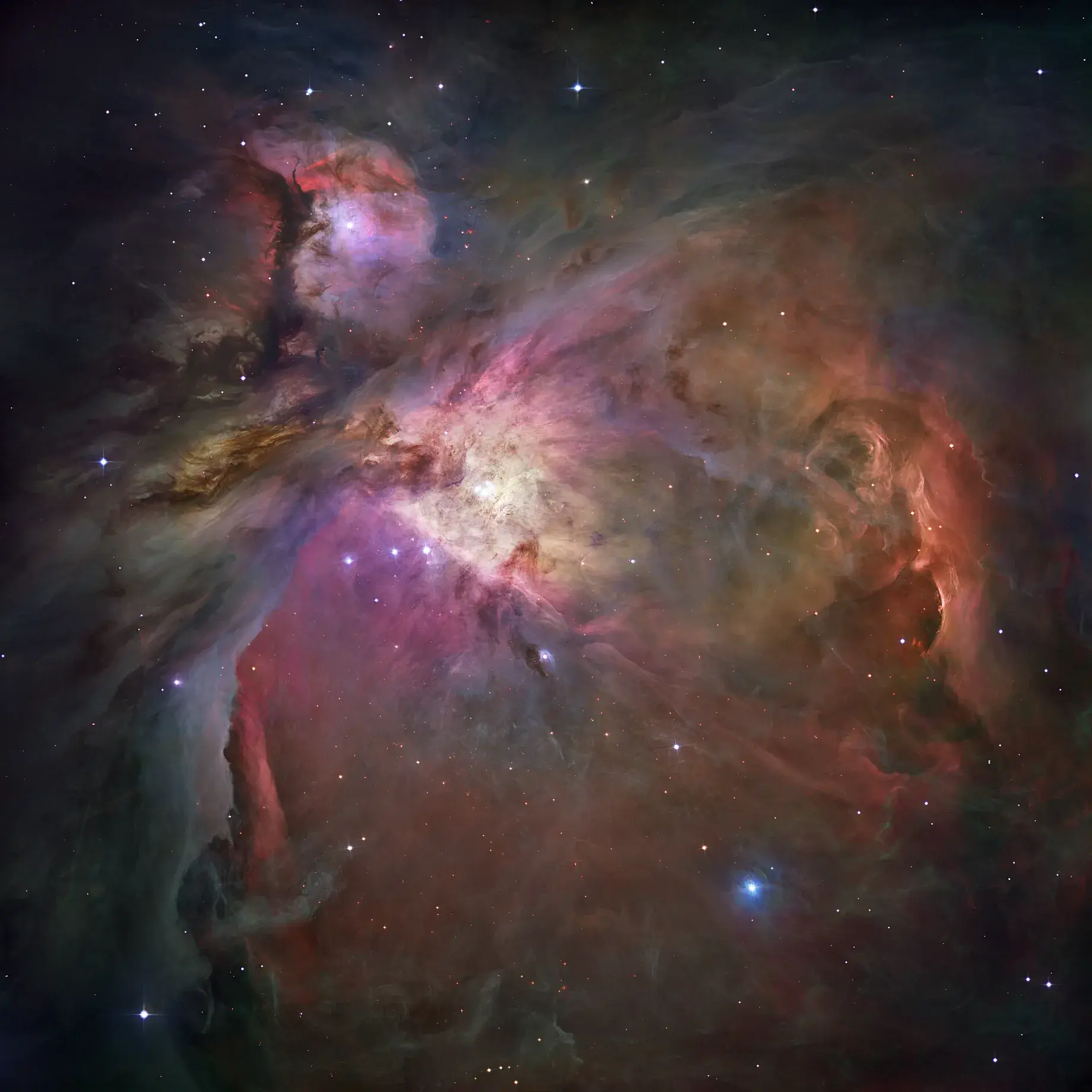
Rarely does a nebula make just one star. A giant cloud fragments as it collapses, and a whole cluster of stars ignites more or less together, from the same batch of gas. The most massive of these newborns are extravagant: they burn hot and blue, flood their surroundings with ultraviolet light, and drive fierce winds of particles. Within a few million years — a blink, in stellar terms — that radiation and those winds carve out the surrounding cloud, lighting it up and, eventually, blowing it apart. The nebula that made the stars is dismantled by the very stars it made. What we see when we photograph a great star-forming region like Orion is precisely this drama frozen in mid-act: brilliant young stars hollowing out and setting aglow the cloud that bore them.
03 — Structure
The anatomy of a cloud
A nebula looks, from a distance, like a single luminous smudge, but a star-forming cloud is a layered structure with distinct regions, each doing a different job. Working outward from the densest, coldest hearts to the glowing skin that faces the young stars:
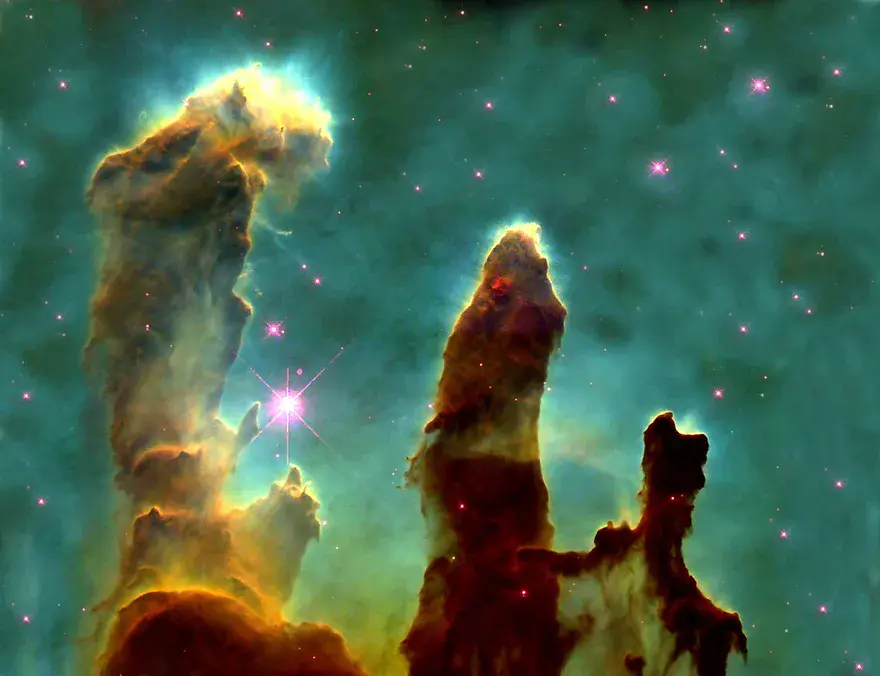
Beyond these lies the region that gives a bright nebula its glow: the H II region, pronounced "H-two," meaning hydrogen that has been ionised — its electrons knocked free by the flood of ultraviolet light from the newborn stars. This is the luminous bubble the young cluster inflates around itself. And threaded through the whole system are stellar winds: streams of particles blown off the hot stars at hundreds of kilometres a second, sweeping the gas into shells, ridges and cavities. The intricate, wind-blown architecture you see in a great nebula image is not decoration; it is the record of an ongoing struggle between the young stars trying to blow their cradle apart and the dense knots of gas stubbornly resisting, some of them holding out just long enough to birth stars of their own.
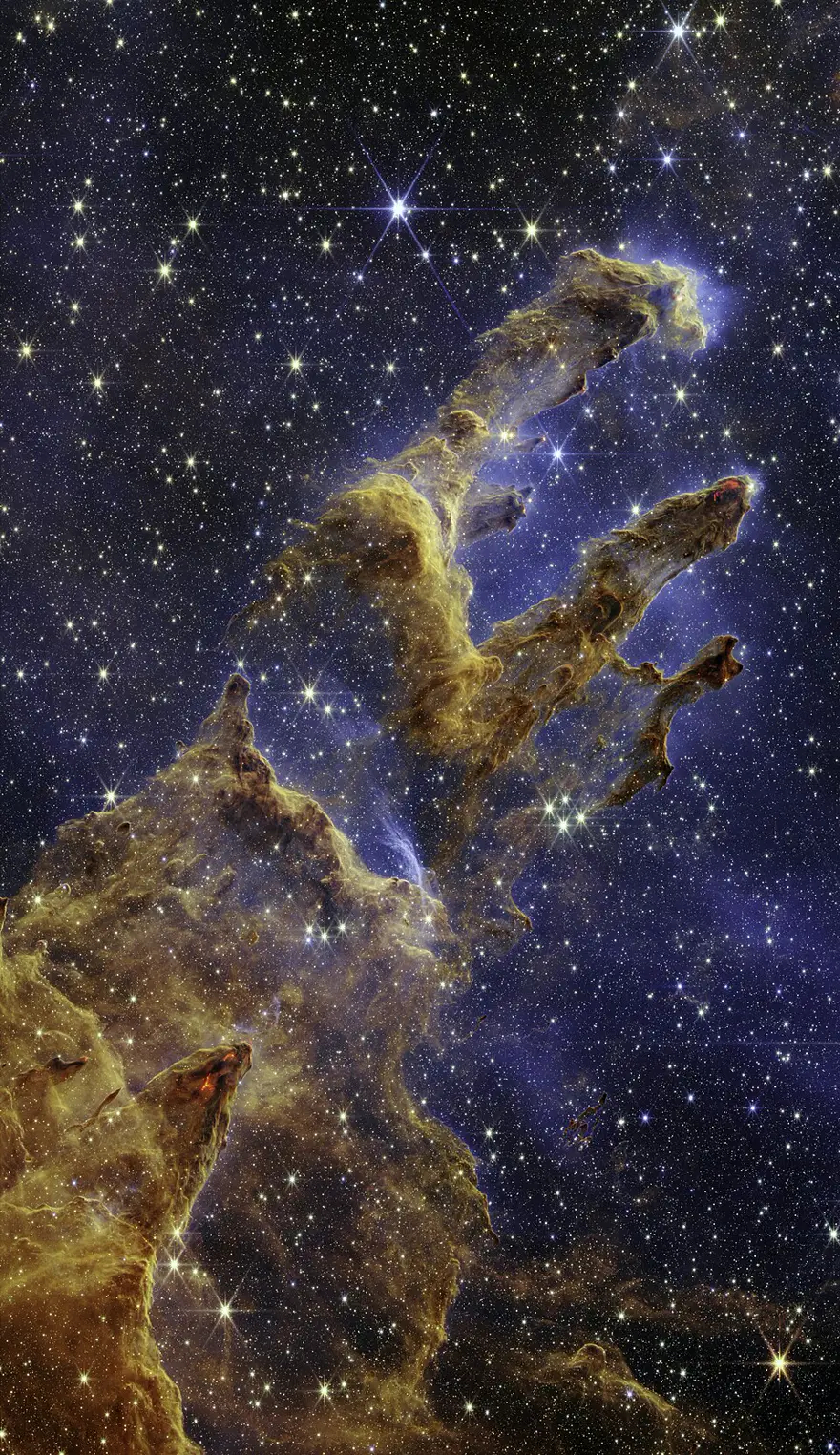
One detail rewards a second look. When you gaze at a pillar or a dark globule silhouetted against the glow, you are watching erosion in slow motion. The radiation from nearby massive stars boils gas off the surface of these dense columns, a process astronomers call photoevaporation. The densest pockets survive longest, so the pillars end up pointing like weathervanes back toward the stars that are destroying them, with the toughest lumps — often forming stars themselves — protected in the tips. In a few million years the pillars will be gone entirely, evaporated into the glowing haze. What looks like a permanent monument is really a fleeting sandcastle against an incoming tide of light.
04 — Taxonomy
Five kinds of cloud
Nebulae are usually sorted not by size but by how they interact with light — whether they emit it, reflect it, block it, or mark the death of a star. Five broad classes cover almost everything you will meet in the sky.
Emission nebulae
These clouds shine with their own light. Ultraviolet radiation from hot young stars strips electrons from the surrounding hydrogen; when those electrons recombine with the atoms, they emit light at very specific wavelengths — most famously a deep red glow from hydrogen. Emission nebulae are the classic stellar nurseries, and their characteristic rose-and-crimson colour is the visible signature of star birth. The Orion Nebula and the Eagle Nebula are textbook examples.
Reflection nebulae
Some clouds do not glow of their own accord but simply reflect the light of nearby stars, like mist caught in a headlamp beam. The dust grains scatter blue light more efficiently than red — the same physics that makes our sky blue — so reflection nebulae tend to shine a cool, ghostly blue. The wisps around the Pleiades star cluster are the best-known case.
Dark nebulae
Not every cloud lights up. Where dense dust lies in front of a bright background — a glowing nebula or a rich star field — it blots out the light behind it, appearing as a hole in the sky. These absorption nebulae, such as the Horsehead and the Coalsack, are darker than the surrounding sky rather than brighter. Yet they are far from empty; they are the densest, coldest clouds of all, and the likeliest sites of future star birth.
Planetary nebulae
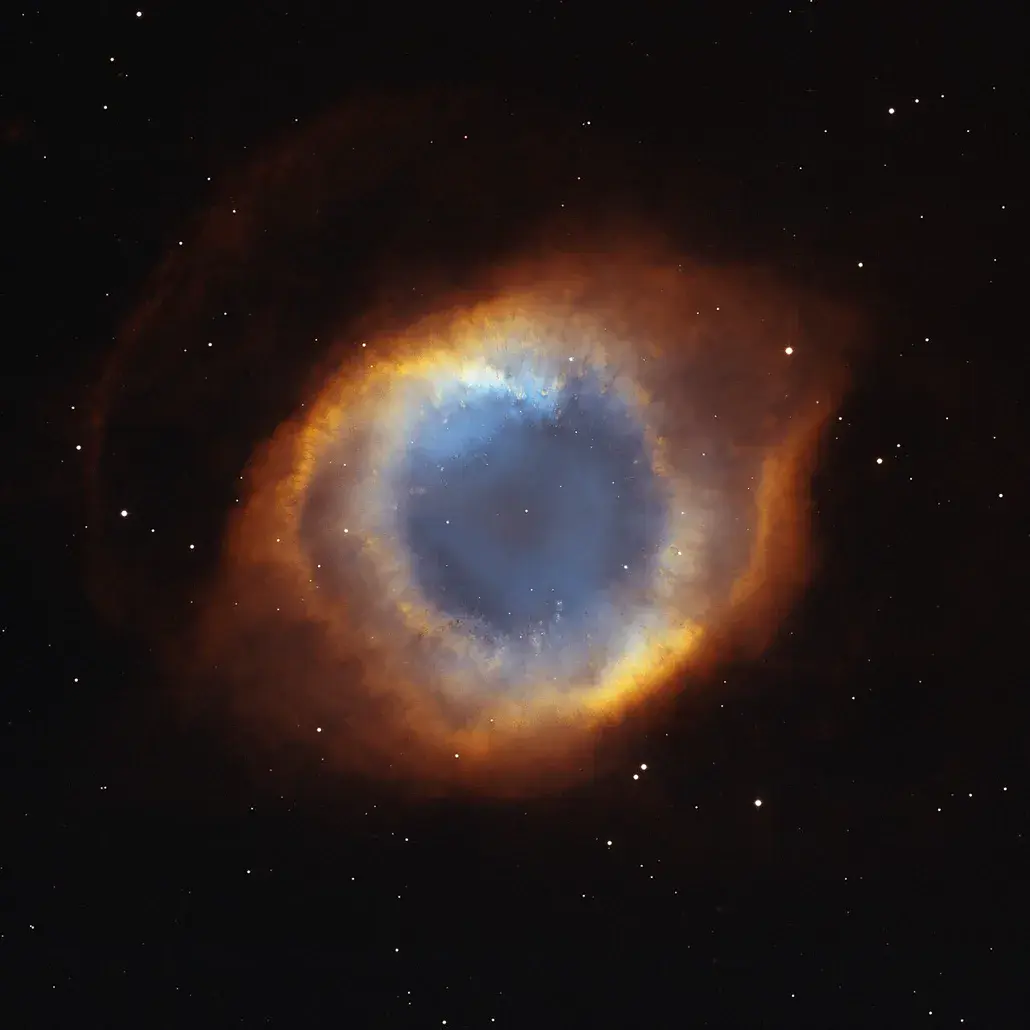
A misleading name — they have nothing to do with planets. When a star like our Sun runs low on fuel, it swells into a red giant and gently sheds its outer layers into space, exposing its hot core. That core's ultraviolet light sets the cast-off shells aglow in delicate rings and shells. Early observers thought the round, greenish disks resembled planets through a small telescope, and the name stuck. The Ring and Helix nebulae are exquisite examples of a Sun-like star's graceful farewell.
Supernova remnants
When a star far heavier than the Sun dies, it does not go quietly — it explodes as a supernova, blasting its outer layers outward at thousands of kilometres a second. The expanding wreckage, ploughing into the surrounding gas and glowing for thousands of years, is a supernova remnant. The Crab Nebula, the debris of a star seen to explode in 1054, is the most famous, still expanding visibly within a human lifetime.
Two ways to glow
The colours of a nebula are not arbitrary. Emission nebulae blaze red because energised hydrogen radiates most strongly at one particular red wavelength; reflection nebulae shine blue because dust scatters short wavelengths best. Read the colour, and you read the physics.
05 — Observation
How do you photograph a cloud?
The glorious images of nebulae that fill our screens are, in an important sense, not what you would see with your own eyes at the eyepiece. The human eye is nearly colour-blind in dim light, so to a visitor peering through even a large telescope most nebulae appear as faint grey wisps. The colour, the depth, the sculpted detail — all of it emerges only from long exposures, careful processing, and observing in kinds of light our eyes cannot register at all. Photographing a nebula is less like taking a snapshot and more like listening to a whole orchestra one instrument at a time.
The reason astronomers reach beyond visible light is dust. The same dark grains that make dramatic silhouettes also block the view: visible light from stars forming deep inside a cloud is absorbed and scattered long before it reaches us, leaving the nursery's most interesting activity hidden. But longer wavelengths slip through. Infrared light — heat radiation — passes through dust far more easily than visible light does, so an infrared telescope can peer straight into the heart of a cloud and see the young stars glowing within. This is precisely why the James Webb Space Telescope, built to see in the infrared, has revolutionised the study of nebulae: it looks through the very curtains that Hubble could only see the outside of.
The colours are chosen
Because much of what a telescope records is invisible to us, astronomers assign visible colours to different wavelengths — a technique often called false-colour or representative-colour imaging. A common scheme maps the light of specific elements to red, green and blue, so that a single picture reveals the distribution of hydrogen, oxygen and sulphur at a glance.
This is not trickery. The colours are deliberate translations of real, measured data into a form our eyes can read — a way of making the invisible visible, and of packing several separate observations into one revealing image.
The full toolkit spans the spectrum. Radio telescopes map the cold molecular gas — the reservoir of future stars — by tuning to the faint emission of molecules like carbon monoxide, which trace the hydrogen that is otherwise almost impossible to detect when it is this cold. Visible-light telescopes capture the glowing H II regions and the fine filigree of ionised gas. Infrared observatories pierce the dust to catch protostars in the act of forming. Ultraviolet and X-ray instruments reveal the hottest gas, the fierce stellar winds and the shock waves of supernova remnants. No single wavelength tells the whole story; only by layering these different views does the complete life of a nebula come into focus. The beautiful pictures are the visible tip of a far larger, mostly invisible, body of evidence.
06 — The physics
Why a cloud of gas glows
It is a fair question why a thin haze of hydrogen, colder or hotter than anything in ordinary experience, should shine at all — and why it shines in such specific, jewel-like colours. The answer is a beautiful piece of atomic physics, and it turns each glowing nebula into a kind of cosmic neon sign, spelling out in light exactly which atoms are present and what is being done to them.
Ionisation
Ultraviolet photons from hot young stars carry enough energy to tear electrons clean off hydrogen atoms, leaving a soup of bare protons and free electrons — an ionised gas, the "H II" of an H II region.
Recombination
Free electrons eventually meet protons and recombine. As an electron cascades down through the atom's energy levels, it releases the surplus energy as light of precise, fixed wavelengths.
Emission lines
Those fixed wavelengths are the nebula's fingerprints. The dominant one for hydrogen is a deep red — which is why so many star-forming nebulae glow crimson.
Follow the process step by step. A hot, massive star pours out ultraviolet light. When one of those energetic photons strikes a hydrogen atom, it can knock the atom's single electron loose entirely — that is ionisation. The gas around the star becomes a warm plasma of free protons and electrons. But the electrons do not stay free forever. Sooner or later a wandering electron is captured by a proton, and as it settles down into the atom it tumbles through a fixed ladder of energy levels, emitting a photon at each rung. Because those energy levels are exactly the same for every hydrogen atom in the universe, the emitted light comes out at exactly the same set of wavelengths. The strongest visible one, produced by a particular jump, is a rich red known as hydrogen-alpha — and it is the reason emission nebulae are so often the colour of a rose.
Reflection nebulae play by a different rule. There is no ionisation and no re-emission there; the dust simply scatters the light of nearby stars. And because tiny dust grains deflect short-wavelength blue light more effectively than long-wavelength red, the scattered glow skews blue — the very same reason the daytime sky overhead is blue while a low sun turns red. So the two commonest nebula colours, red and blue, encode two completely different physical stories: red is gas being energised and radiating; blue is starlight merely bouncing off dust. A single glance at the palette tells a trained eye which is which.
Other colours fill in further detail. Oxygen, when doubly ionised in the low-density conditions of a nebula, produces a distinctive blue-green glow through so-called "forbidden" transitions — emission so faint it can only happen in a gas thin enough that atoms almost never collide, which is exactly the situation in space and almost impossible to reproduce on Earth. This is why nebular spectroscopy was historically so puzzling: astronomers saw emission lines that matched no earthly element, and briefly proposed a new one, "nebulium," before realising they were seeing ordinary oxygen behaving in a way only the vacuum of space allows.
05½ — The cosmic cycle
From cloud to star to cloud again
The single most important idea in this whole guide is that a nebula is not a fixed object but a stage in a loop. Matter flows around and around this loop over billions of years, and every turn of it leaves the universe a little richer in the ingredients of complexity. It is worth walking through the full circuit, because it ties every kind of nebula together into one continuous story.
A cloud becomes stars
A cold molecular cloud fragments and collapses under gravity, igniting a cluster of new stars and lighting up as a glowing emission nebula. The gas that does not end up in stars is blown away.
Stars forge new elements
Over their lifetimes, stars fuse hydrogen into helium and, in heavier stars, on up to carbon, oxygen, and iron. The periodic table beyond hydrogen and helium is largely built inside stars.
Dying stars give it back
Sun-like stars puff off planetary nebulae; massive stars explode as supernovae, which also forge the heaviest elements. Either way, enriched material is flung back into the interstellar medium.
The next generation begins
That enriched gas cools, gathers, and forms fresh molecular clouds — now seeded with the carbon, oxygen and iron needed for rocky planets. The loop closes, and begins again.
Our own Sun and its planets are the product of at least one such turn, probably several. The very fact that the Earth is made of rock and metal rather than pure hydrogen tells us that the cloud which formed the Solar System had already been enriched by earlier generations of stars that lived, died, and returned their ashes to the interstellar medium. When you hold a piece of iron, you are holding atoms that were once inside a star that exploded before the Sun was born, drifted for an age as part of a nebula, and were swept up into the cloud that became our home. A nebula, in other words, is not just something distant and beautiful to look at. It is a stage in a process that produced you.
06½ — A short gallery
Six clouds worth knowing
Theory comes alive when it is attached to real objects, and a handful of nebulae have become touchstones — each illustrating a different facet of the story, each a favourite target for telescopes and stargazers alike. A brief tour of the most celebrated will anchor everything above to points you can actually find in the sky.
The Orion Nebula is the one to start with. Visible to the naked eye as the fuzzy middle "star" in Orion's sword, it is the nearest large stellar nursery, about 1,344 light-years away and some 24 light-years across. At its heart sits the Trapezium, a knot of hot young stars whose radiation lights the whole cloud, and around them Hubble has catalogued hundreds of protoplanetary disks — solar systems caught in the act of forming. If you want to see star birth with your own eyes, Orion is where to look.
The Eagle Nebula gave us the most famous astronomical image ever taken: the Pillars of Creation, three towering columns of dust and gas being slowly eroded by the ultraviolet glare of nearby stars, with new stars condensing in their tips. Hubble's 1995 portrait made the abstract idea of a "stellar nursery" suddenly, unforgettably concrete, and JWST's later infrared view revealed the young stars hidden inside. The Carina Nebula, one of the largest and brightest in the sky, offers similar drama on an even grander scale, home to some of the most massive and unstable stars known.
At the other end of a star's life stand the death-nebulae. The Ring Nebula and the Helix Nebula are both planetary nebulae — the gently shed outer layers of dying Sun-like stars, glowing under the ultraviolet light of the exposed stellar cores at their centres. The Helix, sometimes nicknamed the "Eye of God," is one of the nearest and most detailed. And the Crab Nebula is the violent alternative: the still-expanding wreckage of a massive star whose explosion was recorded by astronomers in the year 1054, with a rapidly spinning neutron star — a pulsar — buried at its core, the crushed remnant of the star that died. Between them these six clouds sketch the entire arc, from cradle to grave and back to cradle.
07 — History
A short history of the clouds
- 964
The first record
The Persian astronomer Al-Sufi describes a "little cloud" in Andromeda — one of the earliest written records of a nebulous object, though it later proved to be a whole galaxy.
- 1054
A star explodes
Chinese and other astronomers record a "guest star" bright enough to see by day. Its expanding wreckage is the Crab Nebula, the first supernova remnant we can trace to a dated event.
- 1610–11
Orion through a telescope
Early observers turn the new telescope on the Orion Nebula, revealing structure invisible to the unaided eye and opening the systematic study of nebulae.
- 1864
A cloud of gas, not stars
William Huggins splits the light of a nebula with a spectroscope and sees bright emission lines — proof that it is glowing gas, not a swarm of unresolved stars.
- 1920s
Nebulae and galaxies split apart
Edwin Hubble shows that many "spiral nebulae" are separate galaxies far beyond the Milky Way, finally distinguishing true gas clouds from distant star-islands.
- 1995
The Pillars of Creation
The Hubble Space Telescope images the Eagle Nebula's columns in unprecedented detail, making star birth vivid to a global audience.
- 2022
Seeing through the dust
The James Webb Space Telescope's infrared eyes peer inside dusty nurseries — the Cosmic Cliffs, the Pillars — revealing young stars hidden from every earlier view.
08 — Common questions
Questions people actually ask
09 — A closing thought
Why we keep looking up at the clouds
There is a temptation to treat nebulae as merely decorative — the postcards of astronomy, prized for their colours and little else. That would be a mistake. Behind the beauty lies the single most consequential process in the visible universe: the making and remaking of matter itself. Every atom heavier than the helium forged in the Big Bang was assembled inside a star and returned to space through a nebula. The clouds are not the backdrop to the cosmic story; they are the machinery that writes it.
What makes them especially worth studying is that they let us watch that machinery run at every stage at once. Look across the sky and you can find clouds on the very brink of collapse, protostars flickering to life inside dusty cocoons, brilliant clusters blowing their nurseries apart, and old stars breathing out the delicate shells that will seed the next generation. No single nebula shows the whole cycle, but the sky as a whole is a gallery of every chapter, playing simultaneously. Astronomy, denied the luxury of watching one cloud through its entire multimillion-year life, instead reads the process from thousands of clouds each frozen at a different moment — a time-lapse assembled from stills scattered across the galaxy.
And the questions are far from closed. Exactly how the first stars condensed from the pristine gas of the early universe, how magnetic fields and turbulence govern the pace of star birth, how the largest stars manage to form at all against their own ferocious radiation, how much of the interstellar medium is locked in cold clouds we still struggle to detect — these remain live frontiers, and telescopes like JWST are rewriting the answers even now. So we keep looking up at the clouds not only because they are lovely, though they are, but because they are the place where the universe keeps turning stardust into stars, and stars back into stardust, in a cycle that made everything solid we have ever known — ourselves included.
The clouds, it turns out, are alive with making.
A nebula is a nursery and a graveyard at once — the place where stars are born from cold gas, and where dying stars return their ashes so the cycle can begin again. Look closely, and the whole story of matter is written in the mist.