01 — Definition
What, exactly, is the Boötes Void?
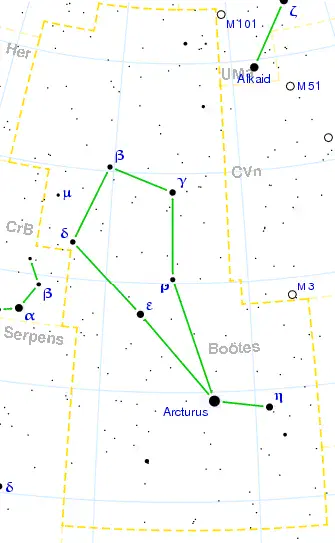
Imagine draining a swimming pool and finding, at the bottom, a single grain of sand where you had expected a bucketful. That, scaled up beyond all human intuition, is the Boötes Void. It is a roughly spherical region of space about three hundred and thirty million light-years in diameter, lying some seven hundred million light-years away in the direction of the constellation Boötes, the Herdsman. Across that colossal volume — large enough to hold thousands of galaxies like our own — astronomers have counted only around sixty. It is one of the emptiest large places we have ever charted, and for a while it was known, only half in jest, as the "Great Nothing."
The word void is doing a lot of quiet work here, so it is worth being precise. A cosmic void is not truly empty in the way the vacuum between atoms is empty; it is not a hole punched clean through space, and it is not a place where the ordinary laws of physics take a holiday. It is simply a region where the density of galaxies falls far below the cosmic average — a stretch of the universe that gravity has, over billions of years, swept almost clean. Voids are defined by comparison. Only when you know how thickly galaxies are strewn across the sky on average can you recognise a place where they are conspicuously absent.
By that measure the Boötes Void is extraordinary. It is not the largest underdense region known — later surveys turned up bigger ones — but it was the first to be recognised as a distinct, enormous, nearly starless bubble, and it remains the archetype. Its galaxy count is perhaps a fortieth of what a comparable patch of "typical" universe would contain. If you were to stand on a planet somewhere near its centre and look up, the night sky would be, to the naked eye, indistinguishable from our own: a scattering of nearby stars. But turn a telescope on the darkness beyond, and you would find it genuinely, unnervingly dark — for hundreds of millions of light-years in every direction, almost nothing.
"If the Milky Way had been in the centre of the Boötes Void, we wouldn't have known there were other galaxies until the 1960s." — a remark long attached to the void, capturing just how isolating that emptiness would be.
That line, repeated in countless retellings, is the quickest way to feel the scale of the thing. Our own understanding of the universe was built on the discovery, in the 1920s, that the faint smudges called "spiral nebulae" were in fact other galaxies, islands of stars unimaginably far away. That revelation was possible only because our nearest large neighbours — Andromeda, the galaxies of the Virgo Cluster — are close enough to resolve. A civilisation marooned near the middle of the Boötes Void would have no such neighbours within easy reach. Its astronomers might have needed telescopes generations more powerful before they could prove that anything at all lay beyond their own island of stars. Emptiness, on this scale, is not merely a geographical fact; it shapes what a mind embedded in it could even come to know.
And yet — this is the crucial subtlety — the Boötes Void is not a perfect vacuum, and its scattering of some sixty galaxies is itself a clue. Those galaxies are not sprinkled at random. Many of them trace a faint tube or bridge running roughly across the void, a ghostly remnant of structure. To the astronomers who study voids, that pattern is a fingerprint of how these regions come to be: not carved out all at once, but assembled slowly from smaller emptinesses that merged, leaving behind the drowned outlines of the walls that once divided them.
02 — Origins
How you stumble upon a hole in the sky
The Boötes Void was found in 1981 by a team led by the American astronomer Robert Kirshner, working with Augustus Oemler, Paul Schechter and Stephen Shectman. They were not hunting for emptiness. They were doing something that sounds almost mundane: measuring the distances to galaxies, one patch of sky at a time, in order to build a three-dimensional map of how matter is arranged in our corner of the cosmos.
The tool that makes such a map possible is redshift. Because the universe is expanding, distant galaxies are carried away from us, and their light is stretched toward the red end of the spectrum by an amount that grows with distance. Measure a galaxy's redshift and you have, in effect, measured how far away it is. A flat photograph of the sky shows only directions; add a redshift to each galaxy and the flat picture springs into depth, revealing which smudges are near and which are far. It is the difference between a star chart and a globe.
Kirshner's team sampled galaxies in several separate directions across the region of Boötes, expecting the usual: a fairly even spread of galaxies thinning gently with distance. Instead they found something jarring. Across a broad band of distances — corresponding to a particular shell of space some hundreds of millions of light-years out — the galaxies simply stopped. Near side: galaxies. Far side: galaxies. In between: a yawning, statistically improbable gap, repeated in every direction they looked. The only conclusion that fitted was that they had blundered into an immense, roughly spherical region almost devoid of galaxies. Careful follow-up over the following years confirmed it and refined its dimensions.
Galaxies counted
Where a typical volume of that size would hold on the order of two thousand, later searches have turned up only around sixty — a fortieth of the expected population.
Its redshift
The void sits at a redshift near 0.05, placing its centre roughly seven hundred million light-years from the Milky Way — near enough to study in detail.
Of the visible cosmos
Its diameter spans about a quarter of one per cent of the diameter of the observable universe — a single feature you could never miss on a map.
What made the discovery matter was not the void alone but what it implied. In 1981 the prevailing mental picture of the universe on the largest scales was of galaxies scattered more or less uniformly, like sugar stirred evenly into tea. A gap this size did not belong in that picture. It hinted that matter on the grandest scales is not smooth at all, but clumped and stranded and hollowed — that the universe has a structure, an architecture, and that voids are one of its defining features. The Boötes Void was among the first pieces of hard evidence that the cosmos is built like a sponge.
03 — Structure
The anatomy of the cosmic web
Zoom out far enough — past individual galaxies, past clusters, past even the great chains of clusters — and the universe resolves into a single, breathtaking pattern that astronomers call the cosmic web. Galaxies are not sprinkled evenly through space; they are strung along threads, gathered at knots, spread across sheets, and everywhere separated by enormous hollows. The web has four basic ingredients, and the Boötes Void is a textbook example of the fourth.
The single most useful analogy for the whole arrangement is a bath of soap suds. In a mound of foam, the air fills the bubbles while the soapy water is squeezed into the thin films between them, and gathers thickest along the edges where three films meet and at the corners where edges converge. Now swap the labels: the bubbles are voids, the films are walls, the edges are filaments, and the corners are clusters. The Boötes Void is one of the bubbles, and the sparse galaxies clinging to its edges are the water in the films around it.
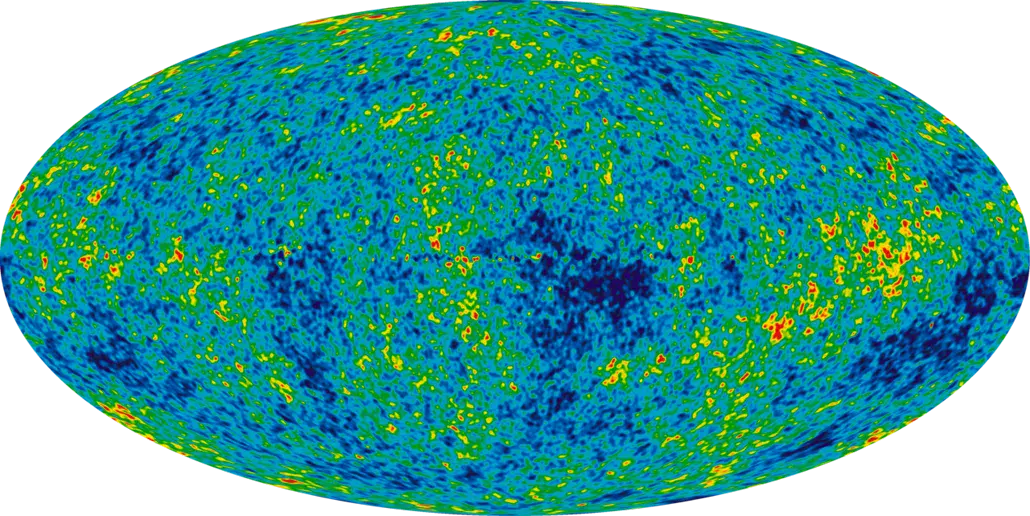
Where did this froth come from? The answer reaches back to the first instants after the Big Bang. The infant universe was very nearly — but not perfectly — smooth. Quantum fluctuations, magnified to cosmic size during a fleeting early burst of expansion called inflation, left behind faint ripples in the density of matter: some regions a hair denser than average, others a hair thinner. We can still see these ripples imprinted on the oldest light in the universe, the cosmic microwave background, where they show up as temperature variations of just one part in a hundred thousand. Tiny as they were, they were the seeds of everything.
From there, gravity did the sculpting, patiently, over billions of years. A region that began slightly denser than its surroundings pulled in a little extra matter, which made it denser still, which let it pull harder — a runaway process that, given cosmic time, gathered matter into filaments and clusters. The slightly under-dense regions did the opposite: with less matter to hold onto, they lost the tug-of-war, their contents drifting outward toward the growing walls and threads around them. An underdensity empties itself. What began as a shallow dimple in the primordial density field deepened, over the age of the universe, into a cavern hundreds of millions of light-years wide. The Boötes Void is what one of those original faint under-dense patches grew up to become.
03½ — A closer look
How empty is empty?
It is tempting to picture a void as a perfect vacuum, an abyss of pure nothing. The reality is stranger and more interesting: a void is a place that is relatively empty, and the relativity is everything. The Boötes Void is thought to hold roughly a third of the density of the average universe — perhaps less at its heart — which means it is under-dense, not un-populated. Its emptiness is measured against a backdrop that is itself, by human standards, almost unimaginably diffuse.
Not zero, just lonely
The sixty-odd galaxies inside the void are real, ordinary galaxies — but they are unusually isolated. Some studies suggest void galaxies tend to be smaller, bluer and more actively forming stars than their crowded cousins, as though the quiet of the void lets them hold on to their gas and keep making stars long after cluster galaxies have run dry.
A tube through the dark
Many of the void's galaxies line up along a rough bridge crossing the emptiness. Astronomers read this as evidence that the Boötes Void formed from the merger of several smaller voids: the bridge is the drowned remnant of a wall that once separated two of them, not yet fully dissolved.
To grasp just how thin "average" density is, consider that if you shrank the whole observable universe down until galaxies were the size of peas, those peas would still sit metres apart, with the void's peas separated by the length of a street. The cosmos is mostly space; the web is a filigree of matter drawn across an overwhelming emptiness. In that sense, the Boötes Void is not an aberration. It is the universe being more thoroughly itself — emptiness taken to its logical extreme.
There is a lesson in that reframing. We tend to think of galaxies, stars and planets as the "stuff" of the universe and the gaps between them as mere backdrop. But by volume, the gaps are the main event. Voids occupy the majority of the cosmos; the luminous structures we cherish are the thin bright borders around the dark. To understand the universe's shape, you have to take its emptiness seriously — and the Boötes Void is the emptiness we know best.
04 — Taxonomy
Four great voids
The Boötes Void is the most famous emptiness in the sky, but it is far from alone. Voids come in a range of sizes, from modest gaps a few tens of millions of light-years wide to contested super-scale rarefactions that may span billions. Here are four worth knowing.
The Boötes Void
The original and the archetype. Discovered in 1981, roughly spherical, and holding only around sixty known galaxies where thousands would be expected, it became the first large void to enter the public imagination. Its fame owes as much to its evocative "Great Nothing" nickname and the haunting image of a galaxy alone at its centre as to its physical dimensions. It remains one of the most studied voids in the sky.
The Local Void
We do not merely observe voids from afar — we live beside one. The Local Void is a large, under-dense region beginning at the very edge of our own Local Group of galaxies and stretching for a hundred million light-years or more. Astronomers have measured our galaxy being gently pushed away from it: as the void empties, its lack of gravity effectively repels the Milky Way toward the denser structures on the far side. Emptiness, it turns out, can shove.
The Giant Void
Lying in the constellation Canes Venatici, the Giant Void is one of the largest reasonably well-established voids known, spanning on the order of a billion light-years. Enormous rarefactions like this push against the fine print of the standard cosmological model, which predicts how big the biggest voids should plausibly be. Each candidate super-void is therefore also a quiet test of whether our model of the universe is complete.
The KBC Void
Named for Keenan, Barger and Cowie, who described it in 2013, the KBC Void is a proposed vast under-density — perhaps twenty per cent below average — surrounding our own region of space, up to two billion light-years across. It is genuinely contentious. But it carries real stakes: if the Milky Way sits inside such a bubble, the local universe would expand slightly faster than the cosmos at large, which some researchers argue could ease the stubborn "Hubble tension" over how fast the universe is expanding. Whether the KBC Void is real, and large enough to matter, is unsettled.
From ripple to cavern
Every void in the sky traces back to a faint cold-or-warm patch on a map like this one. The blotches are density variations of a hundred-thousandth part, frozen into the oldest light we can see. Under-dense patches became voids; over-dense ones became the walls and clusters that hem them in.
05 — Observation
Mapping the universe, one redshift at a time
You cannot recognise a void until you have mapped what surrounds it, and mapping the universe in three dimensions is one of the great collective labours of modern astronomy. It means measuring the distance to galaxy after galaxy, hundreds of thousands and then millions of them, and assembling the results into a single vast atlas of where everything is. The Boötes Void was an early, dramatic result of that effort; the maps that came after turned it from an oddity into a pattern.
The breakthrough came in the mid-1980s with the Center for Astrophysics (CfA) Redshift Survey. When Valérie de Lapparent, Margaret Geller and John Huchra plotted a thin slice of the nearby universe in 1986 — every galaxy's position deepened by its redshift — the result stopped the field in its tracks. Instead of a random spray of dots, the slice showed galaxies gathered along curving filaments that arched around great empty circles, like a cross-section through a bath of bubbles. One striking arrangement even looked, to some, like a stick figure. The universe, the map announced, was frothy. Voids were not rare accidents; they were everywhere, and structure ran through the cosmos like the grain in wood.
The first slices
The CfA survey mapped tens of thousands of galaxies and revealed the bubbly, filamentary texture of the local universe for the first time. It also traced the "CfA2 Great Wall", an immense sheet of galaxies stretching across the map — proof that walls and voids were partners.
A quarter-million galaxies
The Two-degree-Field Galaxy Redshift Survey, run from Australia, measured redshifts for around 220,000 galaxies. Its wedge-shaped maps showed the cosmic web in unprecedented richness and let cosmologists start measuring its statistics, not just admiring its shape.
The great atlas
The Sloan Digital Sky Survey mapped millions of galaxies and quasars across a huge fraction of the sky, producing the most detailed three-dimensional charts of the universe ever made — and revealing the Sloan Great Wall, one of the largest known structures in the cosmos.
The web, recreated
The Millennium Simulation followed billions of virtual particles under gravity from the early universe to today. Starting only from the faint ripples seen in the microwave background, it grew a cosmic web — filaments, clusters and voids — that looked strikingly like the real maps. Emptiness, it confirmed, is exactly what gravity predicts.
The interplay between the surveys and the simulations is the quiet triumph of the whole story. The surveys tell us what the universe actually looks like. The simulations start from the primordial ripples and a recipe of ordinary matter, dark matter and dark energy, and let a computer evolve them forward. When the simulated web comes out looking like the observed one — same froth, same filaments, same voids of the same typical size — it is powerful confirmation that we understand, at least in broad strokes, how the universe assembled itself. The Boötes Void, once an anomaly, becomes a data point that any correct theory of cosmic structure must reproduce.
06 — Why it matters
What emptiness can teach us
It would be easy to file voids under "cosmic curiosities" and move on. That would be a mistake. Precisely because they are so empty, voids are among the cleanest laboratories in cosmology. A galaxy cluster is a maelstrom of messy, hard-to-model physics — colliding gas, exploding stars, feeding black holes. A void is nearly pristine, its evolution governed by little more than gravity and the smooth push of dark energy. That simplicity makes voids extraordinarily sensitive probes of the ingredients and history of the universe.
Testing dark energy
The number and size of voids depend on the tug-of-war between gravity, which resists their growth, and dark energy, which accelerates it. Count the voids in a survey and you constrain how much dark energy there is and how it behaves — an independent line on the universe's most mysterious ingredient.
The ISW imprint
In a universe dominated by dark energy, light crossing a void loses a touch of energy that it never fully regains, arriving very slightly cooler. This "integrated Sachs–Wolfe" effect stamps a faint cold shadow of large voids onto the microwave background — a direct fingerprint of dark energy at work.
Void lensing
Having less mass than average, a void bends passing light the opposite way to a cluster, subtly de-magnifying the galaxies behind it. Measuring this gentle "under-lensing" weighs the void, tests how gravity behaves on the largest scales, and probes dark matter where there is least of it.
Consider the integrated Sachs–Wolfe effect more closely, because it is a lovely piece of physics. Light climbing out of a dense region loses energy on the way up, like a ball rolling uphill; light falling into one gains it. In a universe without dark energy, the loss and the gain cancel out perfectly, and the light emerges unchanged. But dark energy makes space stretch while the light is in transit, so that the hill has flattened slightly by the time the photon reaches the far side. Crossing a void, light rolls down a shallower slope than it climbed, and comes out marginally cooler. The effect is minuscule for any single void, but stack the maps of thousands of voids and the cold imprint appears — a way of seeing dark energy's influence written directly onto the sky.
Then there is the most speculative and irresistible idea of all, and it must be flagged clearly as unsettled. One of the strangest features of the microwave sky is the CMB Cold Spot, a patch that is anomalously, puzzlingly cold — colder than the standard picture comfortably predicts. One proposed explanation is that a colossal supervoid lies along our line of sight to it, chilling the light that passes through by the integrated Sachs–Wolfe mechanism. A large under-density has indeed been reported in roughly that direction. But whether it is big enough to account for the Cold Spot, and whether the Cold Spot needs such an explanation at all rather than being a rare statistical fluke, remains genuinely debated. It is a tantalising maybe, not a settled fact — exactly the kind of open question that keeps the study of voids alive.
06½ — Field notes
Voids as cosmic laboratories
There is a further, subtler reason cosmologists prize voids: they are places where the exotic can show itself. Dark matter and dark energy are hard to study precisely because, in most of the universe, they are tangled up with the bright complications of ordinary matter. Inside a void, the ordinary matter thins away, and the dark components are left to act almost alone. If our theories of the dark universe are even slightly wrong, a void is one of the best places for the discrepancy to surface.
Where new forces would hide
Some alternatives to Einstein's gravity predict that the strength of gravity should differ in under-dense regions, where its usual effects are "unscreened". Voids are therefore prime hunting grounds for deviations that would be invisible in the dense, screened environments of clusters and galaxies.
A sphere that must look round
Voids should be, on average, spherical. If we assume the wrong expansion history for the universe, they appear stretched or squashed in our maps. Insisting that stacked voids come out round pins down the geometry of the cosmos — a clever test that turns emptiness into a ruler.
None of this would have seemed plausible in 1981, when the Boötes Void looked like an embarrassing gap in the data. The arc of the story is that a feature first met as an anomaly — a hole where galaxies ought to be — has matured into an instrument. We have learned to read the sizes, shapes and shadows of voids the way a geologist reads strata, extracting from their emptiness a record of the forces that shaped them. The Great Nothing turns out to have a great deal to say.
07 — History
A short history of cosmic emptiness
- 1970s
The first redshift surveys begin
Astronomers start systematically measuring galaxy distances, laying the groundwork for three-dimensional maps and, with them, the very possibility of noticing a void.
- 1981
The Boötes Void is discovered
Robert Kirshner, Augustus Oemler, Paul Schechter and Stephen Shectman report an enormous, nearly empty region in the direction of Boötes — the first great void recognised as such.
- 1986
The frothy universe revealed
The CfA survey slice by de Lapparent, Geller and Huchra shows galaxies strung around empty bubbles, establishing that voids and walls are a universal pattern, not a one-off.
- 1989
The Great Wall
Geller and Huchra map an immense sheet of galaxies hundreds of millions of light-years long — a dramatic demonstration that voids come bordered by equally dramatic walls.
- 2003
Surveys go industrial
The completed 2dF survey and the growing Sloan Digital Sky Survey chart the web across huge volumes; the Sloan Great Wall emerges as one of the largest known structures.
- 2005
The Millennium Simulation
A landmark computer simulation grows a realistic cosmic web from primordial ripples, matching the observed froth of filaments and voids and confirming the gravitational recipe.
- 2013–15
Super-voids and tensions
The proposed KBC Void reframes the Hubble-tension debate, and a large supervoid is reported toward the CMB Cold Spot — keeping the cosmology of emptiness firmly at the frontier.
08 — Common questions
Questions people actually ask
09 — A closing thought
Why we go looking in the empty places
There is a particular kind of humility in the study of voids. For most of history, astronomy meant looking toward the light — cataloguing stars, resolving galaxies, chasing the brightest and most violent objects in the sky. The voids demanded the opposite discipline: to take seriously the places where there was nothing to see, and to ask why. The Boötes Void was found not because it shone but because it refused to, a silence in the data that turned out to be more eloquent than any signal.
That silence rewrote the map. Before the void, the universe on its largest scales was imagined as a smooth, even scattering of galaxies. After it, and after the frothy survey slices that followed, we came to see the cosmos as a web — a filigree of filaments and walls and clusters drawn across an overwhelming darkness, with voids as the dominant feature by sheer volume. We are not the centre of a uniform sea of stars. We are inhabitants of a thin bright thread, one strand in a structure whose emptiness is its most abundant ingredient.
And the emptiness keeps giving. What began as an anomaly has become one of cosmology's finest instruments: a way to weigh dark energy, to test gravity on the grandest scales, to probe the dark universe where it is least disguised. The deepest questions the voids pose — how large a void the standard model truly permits, whether a supervoid chills the Cold Spot, whether we ourselves sit inside a rarefied bubble that skews our measurement of the whole — are still open. That is not a failure. It is an invitation. The universe has drawn its architecture in bright lines around dark hollows, and asked us to read it. We have only just learned the alphabet.
The emptiness, it turns out, has architecture.
Four decades ago the Boötes Void was a hole where galaxies should have been. Today it stands as our clearest window onto the cosmic web — and the questions it raises about dark energy, the shape of space, and our own place in the froth are still, gloriously, open.