01 — Definition
What, exactly, is nuclear fusion?
Take two of the lightest atomic nuclei in existence — say, two heavy cousins of hydrogen — and force them close enough together, and something remarkable happens. They refuse, and refuse, and refuse, because both carry a positive electric charge and like charges repel with ferocious insistence. But push them close enough that a different, far stronger force takes over at very short range, and they snap together into a single, heavier nucleus. In that instant the newly minted nucleus weighs very slightly less than the two ingredients did apart. That missing sliver of mass has not vanished; it has been converted, with brutal efficiency, into energy. Multiply the tiny loss by the speed of light squared, and a pinprick of matter becomes a flood of power. That is fusion: light nuclei merging, and a whisper of mass becoming a shout of energy.
The bookkeeping runs on the most famous equation in physics, Einstein's E = mc². Because the speed of light, c, is such an enormous number, and squaring it makes it colossal, even a featherweight of mass corresponds to a torrent of energy. When two nuclei fuse, the products are bound together a touch more tightly than the reactants were, and that difference in binding energy is paid out as the kinetic energy of the flying-apart products — heat, in other words, and fast neutrons, and gamma rays. It is the same currency that powers the Sun, the hydrogen bomb, and, we hope, the power stations of some future century.
To understand why fusion releases energy at all, it helps to picture a curve that physicists call the binding energy per nucleon. Every element sits somewhere on it. The lightest elements — hydrogen, helium — sit low and loosely bound; iron and nickel sit at the very bottom, the most tightly bound of all; and the heaviest elements, uranium and beyond, climb back up. Nuclear energy is simply the business of sliding downhill toward iron. Heavy nuclei get there by splitting apart — that is fission, the reaction in today's power plants. Light nuclei get there by joining together — that is fusion. Both roads lead to iron, and both release energy on the way, but fusion of the very lightest elements releases far more per kilogram than fission does, because the climb down from hydrogen is so steep.
"We are, all of us, the ash of dead stars — and every atom heavier than helium in your body was forged in a furnace of fusion." — a sentiment that reframes the periodic table as a family history.
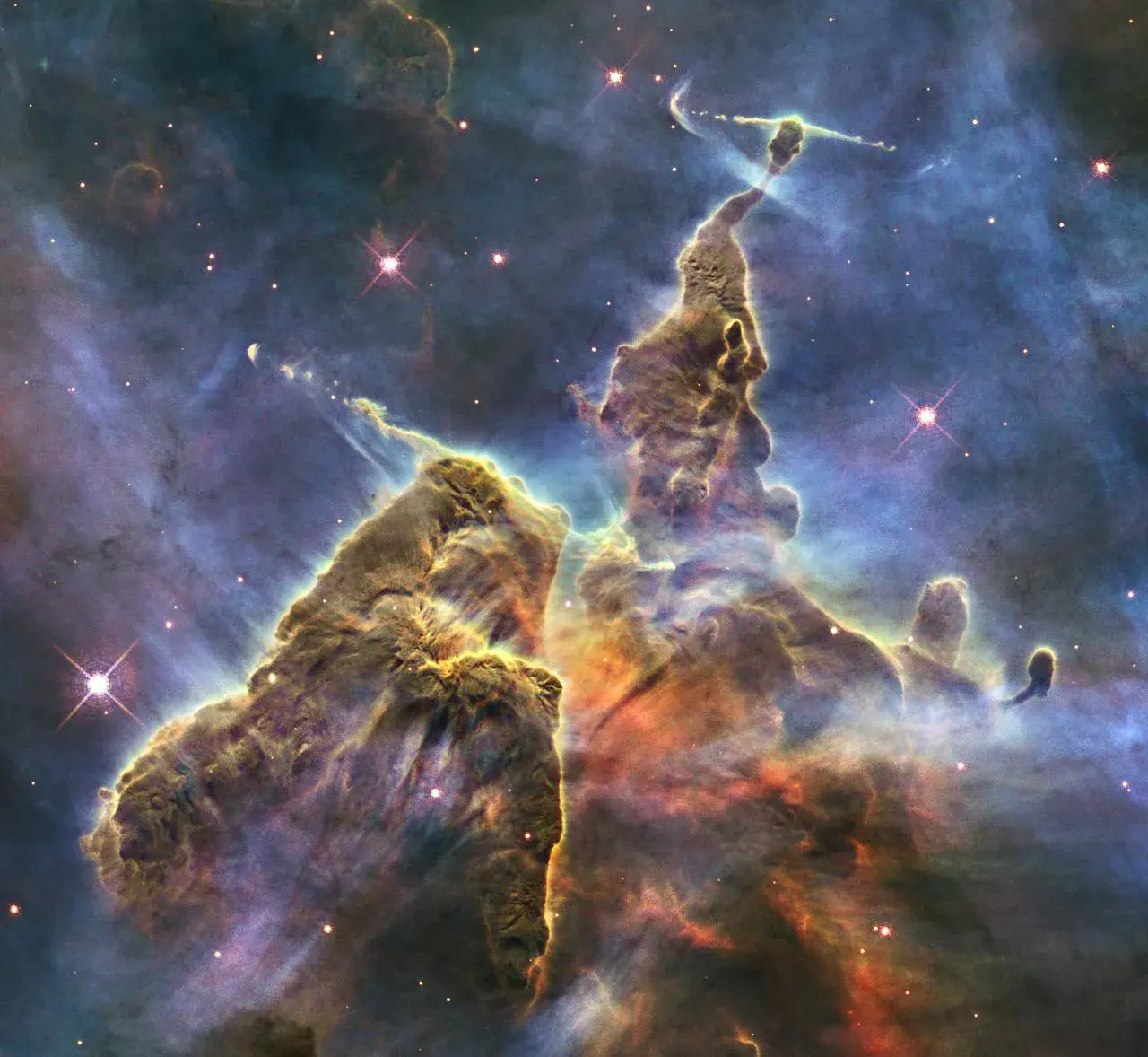
There is a lovely symmetry hidden here. Fusion is not some exotic laboratory trick; it is the ordinary business of the universe. The Sun runs on it. So does every star you have ever seen. The carbon in your cells, the oxygen in your lungs, the calcium in your bones — nearly every atom heavier than the hydrogen and helium made in the Big Bang was assembled, nucleus by nucleus, inside stars, by fusion, and then scattered across space when those stars died. To study fusion is, in a real sense, to study where we came from. The challenge that has consumed physicists and engineers for the better part of a century is not whether fusion works — the sky is proof enough of that — but whether we can coax it to work in a box on Earth, reliably, and get more energy out than we put in.
That last clause is where all the difficulty lives, and it is worth stating the misconception plainly before we go further. Fusion is not "free energy," and building a reactor is not a matter of striking a match. The Sun manages fusion by being unimaginably vast, crushing its core under the weight of a third of a million Earths. We have no such luxury. On Earth we must reach conditions in some ways even more extreme than the Sun's core, hold them steady, and harvest the result — all without melting the apparatus. It is one of the hardest engineering problems humanity has ever set itself, and this guide is, in large part, an honest account of that difficulty.
02 — Fusion in the stars
How the Sun keeps the lights on
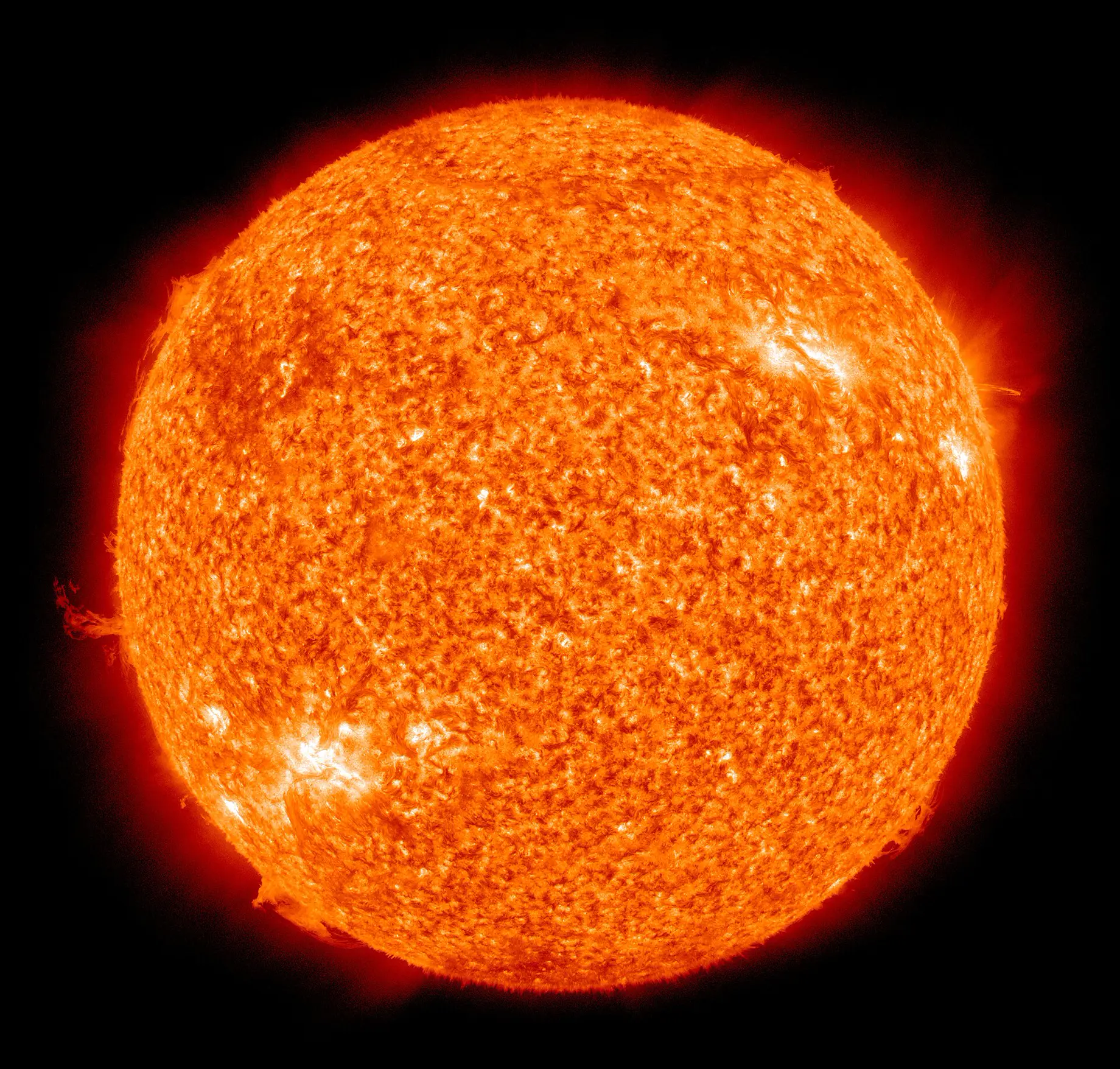
Our Sun is a fusion reactor about 1.4 million kilometres across, held together by nothing more than its own gravity. Deep in its core, the pressure of all that overlying material squeezes hydrogen to a density around thirteen times that of solid lead, and heats it to roughly fifteen million degrees Celsius. Under those conditions the atoms are stripped bare — a soup of naked nuclei and free electrons called a plasma, the fourth state of matter — and the nuclei are forced close enough, often enough, that a small fraction of them fuse.
The Sun's chief recipe is the proton–proton chain. In its first and slowest step, two protons — the nuclei of ordinary hydrogen — collide, and one of them undergoes a subtle transformation, turning into a neutron and binding to the other to make a nucleus of deuterium, or heavy hydrogen. This step is so improbable that any given proton in the Sun's core waits, on average, billions of years before it fuses. That staggering reluctance is a hidden blessing: it is why the Sun burns slowly and steadily over ten billion years rather than detonating all at once. From deuterium the chain proceeds more briskly, building up to helium and releasing energy at each stage.
In hotter, heavier stars a second recipe dominates: the CNO cycle, in which carbon, nitrogen and oxygen nuclei act as recyclable catalysts, shuttling protons around a loop that once again fuses four hydrogen nuclei into one helium nucleus. The catalysts are handed back unchanged at the end, ready to run the loop again. The CNO cycle is exquisitely sensitive to temperature, so it takes over in stars only a little more massive than the Sun and runs their cores far hotter and faster.
Core temperature
Hot by any earthly standard, yet surprisingly cool for fusion — the Sun makes up for it with immense density and simple patience.
Mass lost per second
Every second the Sun converts roughly four million tonnes of matter into pure energy — and has done so, barely dimming, for 4.6 billion years.
Hydrogen-burning life
The Sun is a little under halfway through its steady hydrogen-fusing phase. Its slowness is what makes life possible at all.
Here is the crucial and slightly humbling lesson for anyone trying to build a reactor. The Sun's core is not especially hot by fusion standards — fifteen million degrees is modest. What the Sun has in abundance is density and time. Its gravity supplies a confinement no earthly magnet or laser can match, holding the plasma together for billions of years so that even absurdly rare reactions eventually add up to a steady, colossal output. The power produced per cubic metre of the Sun's core is actually rather feeble — comparable, litre for litre, to a compost heap. The Sun is luminous not because it fuses furiously but because it is so enormous. On Earth, denied that vastness, we must compensate by making our plasma very much hotter — well over a hundred million degrees — so that reactions happen fast enough to be useful in a machine we can actually build and hold.
Stars are also the universe's forges. As a massive star ages, it fuses hydrogen to helium, then helium to carbon and oxygen, then onward through neon, silicon and the rest, building an onion of shells until its core is iron — the point where fusion stops paying out. That entire chain of stellar nucleosynthesis is why the cosmos contains anything interesting at all. Every carbon atom in a diamond, every oxygen atom in the sea, was fused in a stellar core and flung outward when the star died. Fusion did not merely light the sky; it stocked the universe with the raw materials of planets, and of us.
03 — The physics of ignition
Hot, dense, and held together
To fuse two nuclei you must overcome their mutual electrical repulsion — the so-called Coulomb barrier — and that means slamming them together at tremendous speed. Speed, for a gas, means temperature. So the first ingredient of fusion is heat, and not a little of it: a practical reactor on Earth must reach a plasma temperature of one to two hundred million degrees Celsius, roughly ten times hotter than the centre of the Sun. At those temperatures matter can only exist as plasma, and no solid container could survive a moment's contact.
But temperature alone is not enough. You also need the hot nuclei packed closely together — high density — so that collisions are frequent, and you need to hold them in that state long enough for the energy released by fusion to exceed the energy leaking away — long confinement time. Physicists fold these three requirements into a single, unforgiving figure of merit.
That figure of merit is the triple product — density multiplied by temperature multiplied by confinement time — and the threshold it must beat is called the Lawson criterion, after the British engineer John Lawson who worked it out in the 1950s. Below the threshold, a plasma leaks heat faster than fusion can replace it, and it fizzles. Above it, the energy released by fusion is enough to keep the plasma hot all by itself — a self-sustaining burn physicists call ignition, the fusion equivalent of a fire that no longer needs a match held to it. Reaching and holding that threshold, in a machine that survives the experience, is the central challenge of fusion energy. Everything else is engineering in service of the triple product.
The two great families of reactor make opposite bets on how to satisfy Lawson. Magnetic confinement runs a diffuse plasma — thinner than the air in this room — at very high temperature and holds it for seconds or longer. Inertial confinement does the reverse: it crushes a speck of fuel to enormous density for a few billionths of a second, so briefly that the fuel's own inertia is all the confinement there is. Both routes aim at the same line on the same graph; they simply approach it from different corners.
04 — Approaches
Four ways to catch a star
There is no single agreed path to fusion power. Instead there is a family of rival approaches, each betting on a different way to satisfy the Lawson criterion. Four broad strategies dominate the field.
The tokamak
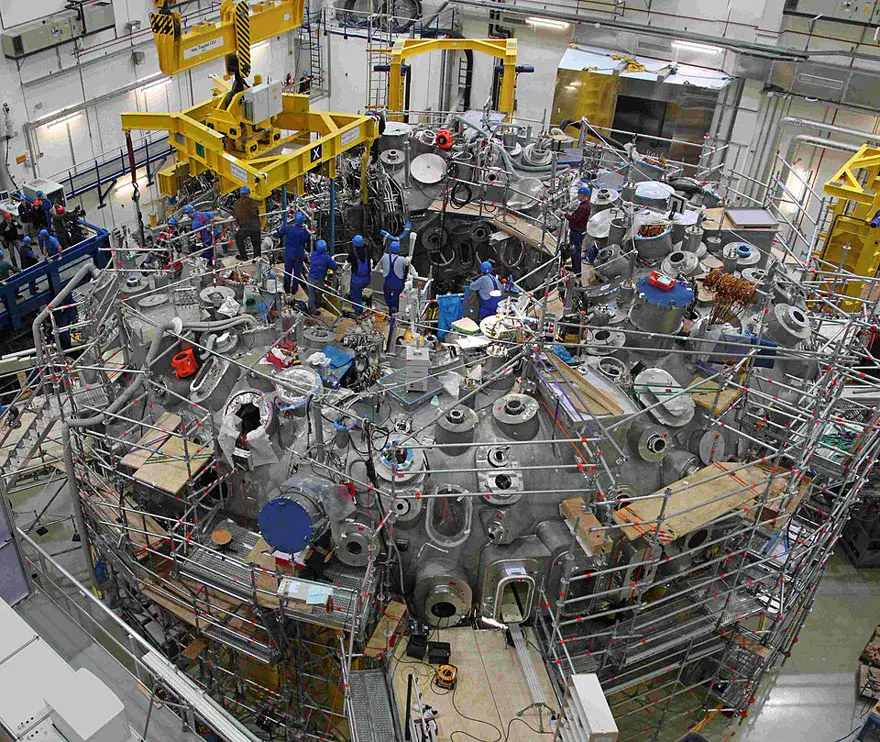
A Soviet invention of the 1960s, the tokamak is a hollow doughnut, or torus, wrapped in powerful electromagnets that bottle the plasma in a ring of magnetic field so it never touches the walls. A current driven through the plasma itself adds a twist to the field lines, which turns out to be essential for stability. The tokamak has produced the best fusion results of any design so far and is the basis of ITER, the giant international reactor now being assembled in France. Its weakness is that the plasma current is fickle and prone to abrupt collapses, and the machine naturally runs in pulses rather than continuously.
The stellarator
The stellarator achieves the same twisted magnetic cage as a tokamak, but builds the entire twist into the shape of its coils rather than relying on a current in the plasma. This makes the coils fiendishly complicated — sculpted, warped forms that only modern supercomputers could design — but it buys a priceless advantage: the plasma can, in principle, burn steadily and continuously, with none of the tokamak's disruptive crashes. Germany's Wendelstein 7-X is the flagship of the revival, and its record-breaking results have made the stellarator a serious contender once more.
Inertial confinement (lasers)
Instead of holding a thin plasma for a long time, inertial confinement crushes a tiny pellet of fuel — a peppercorn of frozen deuterium and tritium — to more than a hundred times the density of lead in a few billionths of a second. The world's largest laser, the National Ignition Facility in California, does this by firing 192 beams at the target so that its surface blows off and the recoil implodes the core to fusion conditions. In December 2022 this approach crossed a historic line, releasing more fusion energy than the laser light delivered to the target — a first for any experiment on Earth.
Private & alternative concepts
A wave of private companies, buoyed by advances in high-temperature superconductors and by billions in investment, is chasing faster, cheaper routes. Some build compact tokamaks with far stronger magnets to shrink the machine; others pursue field-reversed configurations, magnetised-target schemes that fire pistons at plasma, or laser designs of their own. The claims are bold and the timelines aggressive; the physics is unforgiving. This corner of the field is the most exciting and the most in need of a sceptical eye.
04½ — A common confusion
Fusion is not fission
Because both are "nuclear," the two are constantly muddled, yet they are near opposites. Fission splits a heavy nucleus — uranium or plutonium — into lighter fragments, and it is the reaction inside every nuclear power station operating today. Fusion joins light nuclei into heavier ones, and no power station on Earth yet runs on it. The distinction matters enormously for safety and waste.
Splitting the heavy
Runs on a self-sustaining chain reaction that must be actively held in check; a loss of control can run away. It leaves behind long-lived, highly radioactive waste that stays hazardous for millennia, and its fuel — enriched uranium — overlaps uncomfortably with weapons material.
Joining the light
Has no chain reaction to run away: the plasma is so hard to sustain that any fault simply snuffs it out in an instant. Its main product is harmless helium; the radioactivity it does create — in the reactor's own walls, from neutron bombardment — decays in decades, not eons, and it cannot melt down.
This is perhaps the single most important thing to understand about fusion's promise. A fusion plasma is not a bomb waiting to be contained; it is a candle flame that keeps trying to go out. The engineering struggle is entirely about keeping it lit, which means that the failure mode of a fusion reactor is not explosion but simply stopping. There is only ever a few seconds' worth of fuel in the chamber at any moment. Whatever else fusion turns out to be, it is inherently incapable of the runaway accidents that haunt the public imagination of nuclear power.
05 — The great machines
The cathedrals of plasma
Fusion research is written in enormous, singular machines — each one a decade-long, billion-pound wager on a particular idea. They are among the most complex objects humans have ever built, and to walk into one of their halls is to stand inside an argument about the future of energy, cast in steel and superconductor. A handful of them carry the whole field on their shoulders.
ITER, being assembled in southern France by a collaboration of thirty-five nations, is the largest tokamak ever attempted — a machine designed to hold a burning plasma and produce, as its central goal, ten times more fusion power than is used to heat the plasma. It is not a power station; it will not put electricity on the grid. It is a scientific proving ground meant to show that a self-sustaining fusion burn can be created and controlled at the scale a real plant would need. Its construction has been famously slow and costly, a genuine and fair criticism, but if it succeeds it will answer questions no smaller machine can.
Where the beams meet
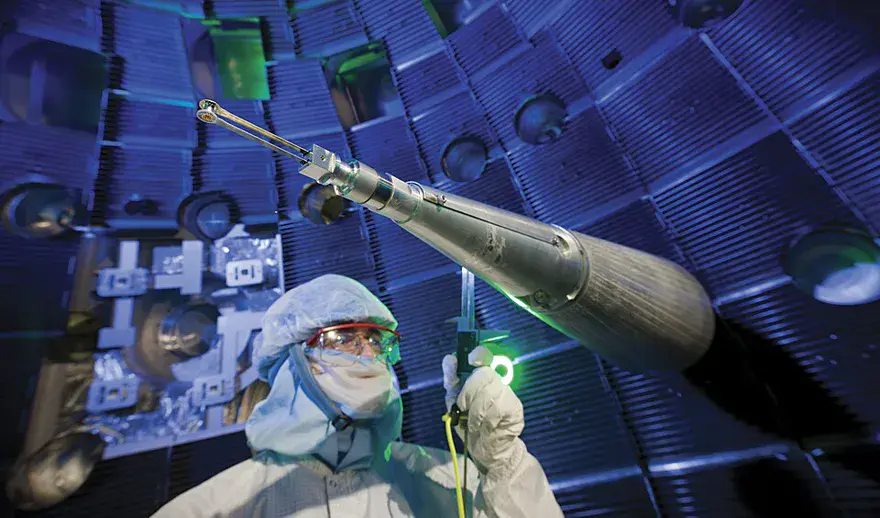
The National Ignition Facility is not really a fusion power project at heart — it was built to study the physics of nuclear weapons without testing them — but in December 2022 it became the first experiment anywhere to release more energy from fusion than the laser light delivered to the target. It was a landmark of scientific principle, even as the lasers themselves drew vastly more power from the wall than the reaction gave back.
The chamber is a ten-metre sphere of aluminium and concrete, pocked with ports for the beams, at whose centre a fuel capsule the size of a peppercorn is crushed in a heartbeat.
JET — the Joint European Torus in Oxfordshire — was for decades the world's flagship tokamak and its record-holder. In 1991 it achieved the first controlled release of significant fusion power on Earth, and in later campaigns it set energy records that stood for years, providing much of the hard experimental data on which ITER's design rests. Having done its work, JET was retired in 2023, closing a chapter of nearly forty years. Wendelstein 7-X in Greifswald, meanwhile, is the great modern stellarator, built to prove that its twisted-coil approach can hold a hot plasma steadily for long durations — a property that may make the stellarator the more practical design for a continuous power plant, if its formidable engineering can be tamed.
What unites these machines is a shared humility. None of them is a power station; every one is a question. Can a plasma be held hotter than the Sun without touching a wall? Can a burning plasma be kept stable when its own fusion heat starts to drive it? Can the materials survive years of neutron bombardment? Each cathedral of plasma is built to answer one part of that puzzle, and only when their answers are stitched together will anyone be able to design a machine that sells electricity.
05½ — The fuel
A glass of seawater
Deuterium from the sea
The favoured fuel is a pairing of two heavy hydrogens: deuterium and tritium. Deuterium is astonishingly abundant — about one hydrogen atom in every 6,400 in seawater is deuterium, so every litre of ocean holds a usable trace. The deuterium in a single glass of water, fully fused, carries roughly the energy of a barrel of oil. The oceans hold enough to power civilisation for many millions of years.
Tritium, the tricky half
Tritium is the awkward partner. It is radioactive, decays with a half-life of about twelve years, and barely exists in nature. The plan is to breed it inside the reactor: the fast neutrons from fusion strike a blanket of lithium lining the walls, and lithium obligingly transmutes into fresh tritium. Making this breeding cycle self-sustaining is one of the great unsolved engineering problems standing between today's experiments and a working plant.
The fuel story is, on balance, one of fusion's strongest cards. There is no scramble for scarce ore, no geopolitics of enrichment, no mountain of spent fuel. The deuterium is in the sea, freely available to any nation with a coastline, and the lithium is a common metal. A fusion plant would sip a few grams of fuel a day and emit no carbon and no long-lived waste. That vision — clean, abundant, and drawn from something as ordinary as seawater — is precisely why the world keeps pouring effort into a problem that has resisted solution for seventy years.
06 — The hard road
Why it is so fiendishly hard
If fusion is the obvious answer to clean energy, why, after seventy years, do we still not have it? The honest reply is that holding a piece of the Sun in a box turns out to be one of the deepest engineering problems ever attempted, and the difficulty is not one obstacle but several, each formidable on its own.
Plasma instabilities
A plasma held in a magnetic bottle is a restless, wriggling thing that finds endless ways to squirm out of confinement, kink, and dump its heat against the wall. Taming these instabilities — some unfolding in millionths of a second — is a science in itself.
Materials
The reactor walls must endure a relentless sleet of high-energy neutrons that damage and embrittle ordinary metals, all while facing a plasma hotter than any furnace. No proven material yet survives decades of that punishment.
Net energy (Q)
The scoreboard is a number called Q — fusion energy out divided by heating energy in. Reaching the elusive Q > 1, and then the far harder goal of a whole plant that produces more electricity than it consumes, has taken generations.
That last measure, Q, deserves care, because it is where hype most often outruns honesty. When the National Ignition Facility announced "ignition" in December 2022, it had genuinely, for the first time, released more fusion energy from the target than the laser light that struck it — a real and historic scientific milestone. But the lasers themselves consumed something like a hundred times more electricity from the grid than they delivered to the target. Measured at the wall socket, the experiment was still deeply in the red. The gap between "more energy than the laser delivered" and "more energy than the plant consumed" is enormous, and closing it is the work of decades, not headlines. A responsible account of fusion must hold both truths at once: the 2022 result was a landmark, and a commercial reactor remains a long way off.
So where do things honestly stand? The physics of fusion is no longer in serious doubt; the question is engineering, economics, and endurance. ITER should, in the 2030s, demonstrate a sustained burning plasma at power-plant scale. A wave of well-funded private companies promises grid electricity in the 2030s, though a sober observer would treat the most aggressive timelines with caution and expect the first real power plants somewhat later. What has genuinely changed in the last decade is the arrival of better superconducting magnets, faster computers to design and control the plasma, and, for the first time, serious private capital alongside the public giants. None of that guarantees success. But fusion has moved, quietly, from a distant dream to a hard engineering programme with a plausible, if uncertain, path to the finish. That is a real and meaningful shift — and it is worth stating without either despair or hype.
07 — History
A short history of a long pursuit
- 1920
Eddington's leap
Arthur Eddington proposes that the Sun shines by fusing hydrogen into helium, converting mass to energy — the first suggestion that fusion powers the stars, made before anyone knew how it could work.
- 1938–39
Bethe cracks the code
Hans Bethe (with contributions from Weizsäcker and others) works out the detailed nuclear reactions — the proton–proton chain and the CNO cycle — by which stars actually burn, earning a later Nobel Prize.
- 1952
The destructive proof
The first thermonuclear device detonates, demonstrating fusion on Earth in the most sobering way possible — as a weapon. It proved fusion was achievable here, and set the field a very different, peaceful goal.
- 1968
The tokamak arrives
Soviet physicists announce startlingly good results from their T-3 tokamak. When British scientists confirm the measurements, the tokamak becomes the dominant design worldwide, a position it holds to this day.
- 1991
First controlled power
The Joint European Torus produces the first controlled release of significant fusion power, briefly generating over a megawatt and opening the era of experiments with real fusion fuel.
- 2022
Ignition at NIF
The National Ignition Facility releases more fusion energy from its target than the laser light delivered to it — the first experiment on Earth to cross that particular line, a genuine scientific first.
- 2030s→
ITER and beyond
ITER aims to demonstrate a sustained burning plasma at power-plant scale, while private ventures race to build the first machines that put fusion electricity on the grid.
08 — Common questions
Questions people actually ask
09 — A closing thought
Why we keep chasing the Sun
There is a particular kind of stubbornness in the pursuit of fusion. For seventy years it has promised a clean, near-limitless source of energy, and for seventy years it has declined to arrive on schedule. Careers have been spent, fortunes have been poured out, and the goalposts have shifted more than once. A reasonable person might ask whether the whole enterprise is a mirage. And yet the reason it endures is that the prize is genuinely enormous, and the physics genuinely works — up there in the sky, every single night, in numbers beyond counting.
What has changed, quietly, is that fusion has stopped being a question of whether and become a question of how and when. We know it can be done, because the stars do it, and because in laboratories we have now released real fusion energy and, in one case, more than the light we put in. The remaining barriers — taming the plasma, hardening the materials, closing the fuel cycle, driving Q high enough at the level of a whole power station — are engineering barriers, immense but not obviously impossible. That is a very different situation from the one physicists faced in the 1950s, when even the basic feasibility was in doubt.
It would be dishonest to end on unqualified optimism. Fusion may yet prove too costly, too slow, or too complex to compete with the tumbling price of solar panels and batteries; clean energy will very likely be won on many fronts long before the first fusion plant sells a kilowatt-hour. But it would be equally dishonest to write fusion off. If it works — even if it works late — it offers something no other source quite matches: a fuel drawn from the sea, no carbon, no meltdown, no long-lived waste, and an energy density that could power a civilisation for as long as there are oceans. That is a wager worth keeping on the table. We chase the Sun not because success is certain, but because the reward, if it comes, would be worth every one of these seventy stubborn years — and because there is something deeply human in trying to light a star of our own.
The fire of suns, within reach — if not yet within our grasp.
Fusion has powered the stars for thirteen billion years. We have proven we can kindle it here, for the briefest instants, and we now know exactly how hard the rest of the climb will be. Whether we finish it or not, the attempt is one of the boldest things our species has ever tried.